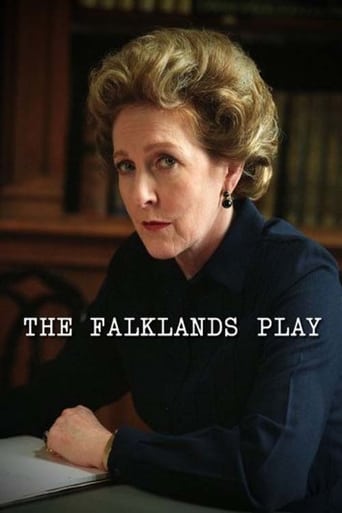
The Falklands Play (2002)
The Falklands Play is a dramatic account of the political events leading up to, and including, the 1982 Falklands War. The play was written by Ian Curteis, an experienced writer who had started his television career in drama, but had increasingly come to specialise in dramatic reconstructions of history. It was originally commissioned by the BBC in 1983, for production and broadcast in 1986, but was subsequently shelved by Controller of BBC One Michael Grade due to its alleged pro-Margaret Thatcher stance and jingoistic tone. This prompted a press furore over media bias and censorship.The play was not staged until 2002, when it was broadcast in separate adaptations on BBC Television and Radio.
- Date of release
- 2002-04-10
- TMDB
- 7.0 / 10 (8)
- Runtime
- 1h 30m
- Genres
- War, Drama, TV Movie
- Director
- Michael Samuels
Casting
- Patricia Hodge — Rt. Hon Margaret Thatcher (Prime Minister)
- John Standing — Rt Hon William Whitelaw CH MC MP (Home Secretary)
- Michael Cochrane — Rt Hon Nicholas Ridley MP (Financial Secretary to the Treasury)
- James Fox — Rt Hon Peter, 6th Baron Carrington KCMG MC (Foreign Secretary)
- Colin Stinton — Alexander Haig (US Secretary of State)
- Anthony Calf — Robin Fearn (Head of Falkland Islands Department, Foreign Office)
- Jeremy Child — Rt Hon Francis Pym MC MP (Foreign Secretary)
- Richard Cordery — Tom Enders
- Robert Hardy — Sir Anthony Parsons
- John Woodvine — Adm. of the Fleet Sir Terence Lewin
- Rupert Vansittart — Sir Robert Armstrong (Cabinet Secretary)
- Jonathan Coy — Richard Luce MP (Minister of State, Foreign Office)
Interesting facts
The Falklands Play is a dramatic account of the political events leading to and during the 1982 Falklands War between the United Kingdom and Argentina. The play was written by Ian Curteis, who had started his television career in drama but had increasingly come to specialise in dramatic reconstructions of history. It was originally commissioned by the BBC in 1983 for production and broadcast in 1986, but was subsequently shelved by controller of BBC One Michael Grade due to its supposed support for the prime minister Margaret Thatcher and jingoism. This prompted a press furore over media bias and censorship.
Production
On 22 October 1982, at a meeting of the Writer's Luncheon Club, BBC Director General Alasdair Milne gave a speech during which he praised Curteis's TV play Suez 1956 (shown three years earlier), which had dealt with the Suez Crisis from the political and diplomatic perspective, rather than the "action" on the ground.
Curteis recommenced work on the play at the start of 1985, meeting many of the key players and visiting most of the locations that would be portrayed in the play. His research also involved reading most of what had already been published about the War, biographies of the chief protagonists, Hansard for the relevant Parliamentary debates, official reports, and the contemporary press coverage.
At a meeting with Milne on 2 June 1986, Curteis raised the question of the general election that was expected to happen the following year, and asked whether it might compromise the planned transmission date of the play. Milne dismissed the possibility of an election before the Autumn of 1987 at the earliest, and stated: "I don't see that transmission in April presents any problem."
In early July the new Head of Plays Peter Goodchild (whose background was in documentaries, rather than drama) requested considerable modifications to the script, amongst them objecting to the portrayal of Thatcher's "private and instinctive self" – as opposed to the "bellicose Iron Lady of the public scenes" – and requesting the inclusion of discussions between members of the government about the possible effect of the War on the 1983 general el…
On 21 July, while Curteis was on holiday in Ireland, the BBC cancelled the play, citing the forthcoming General Election. Curteis mounted a robust defence, and as the press became involved at the end of September, pressure mounted on the BBC, especially when it was discovered that they were going ahead with Charles Wood's Tumbledown, which was claimed to have an "anti-Mrs-Thatcher's-Government theme," even though at that point Wood's script had n…
Read on Wikipedia · Text from Wikipedia, CC BY-SA 4.0. Data from Wikidata.
Recommended
- The One That Got Away 1957 · ★ 6.8
- The Devil's Brigade 1968 · ★ 6.3
- The Court-Martial of Billy Mitchell 1955 · ★ 6.8
- The Last Rifleman 2023 · ★ 6.6
- Fixed Bayonets! 1951 · ★ 6.5
- Waiting for Anya 2020 · ★ 6.3
- Cast a Giant Shadow 1966 · ★ 6.3
- Blood on the Sun 1945 · ★ 5.9
- Story of G.I. Joe 1945 · ★ 6.5
- Taking Sides 2002 · ★ 6.3
- The War Below 2021 · ★ 6.6
- The Dam Busters 1955 · ★ 6.9