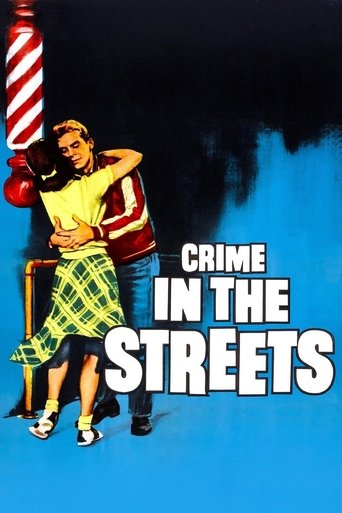
Crime in the Streets (1956)
How can you tell them to be good when their girl friends like them better when they're bad!...
A social worker tries to end juvenile crime by getting involved with a street gang.
- Date of release
- 1956-06-10
- TMDB
- 6.2 / 10 (27)
- Runtime
- 1h 31m
- Genres
- Crime, Drama, Thriller
- Director
- Don Siegel
Casting
- James Whitmore — Ben Wagner
- Sal Mineo — Angelo 'Baby' Gioia
- John Cassavetes — Frankie Dane
- Mark Rydell — Lou Macklin
- Virginia Gregg — Mrs. Dane
- Peter J. Votrian — Richie Dane (as Peter Votrian)
- Will Kuluva — Mr. Gioia
- Malcolm Atterbury — Mr. McAllister
- Denise Alexander — Maria Gioia
- Dan Terranova — Blockbuster
- Steve Rowland — Glasses
- Duke Mitchell — Herky
Interesting facts
Crime in the Streets is a 1956 American crime drama film about juvenile delinquency directed by Don Siegel and based on a television play written by Reginald Rose. The play first appeared as an episode of The Elgin Hour directed by Sidney Lumet before being remade as a feature film directed by Don Siegel.
Production
The success of Marty had led to a boom in film adaptations of television plays and film rights to Crime in the Streets were bought by Allied Artists. Rose was paid $25,000 plus 10% of the profits. He wanted Lumet to direct. Lumet went on to direct another film based on a Rose television play, Twelve Angry Men. Don Siegel had directed a number of films for Allied Artists and the studio asked him to direct the movie version.
The original television script was turned down by the Hollywood Production Code for being too brutal. The script was reworked to get approval. Siegel wrote in his memoirs that he never met Reginald Rose but heard from producer Vincent Fennelly that Rose was unhappy with some changes the director made to the script.
Production of the film led to the cancellation of another film that was going to be made by Allied Artists from William F. Broidy called Sweet Violence. It was felt the plots of the two movies were too similar.
Filming started 4 November 1955. The bulk of the film was shot on a single set, which Siegel described "a sort of expressionistic view of a New York street designed by Serge Krisman and lighted impressively by cameraman Sam Leavitt." Siegel said the set cost $35,000 but it saved him time in terms of shooting.
Siegel said "I liked the picture, but it came in the wake of a number of good juvenile delinquency pictures such as The Blackboard Jungle and Rebel Without a Cause."
Read on Wikipedia · Text from Wikipedia, CC BY-SA 4.0. Data from Wikidata.
Recommended
- The Young Savages 1961 · ★ 6.5
- Each Dawn I Die 1939 · ★ 6.9
- Redemption: The Stan Tookie Williams Story 2004 · ★ 6.1
- Dead End 1937 · ★ 7.0
- The Quiller Memorandum 1966 · ★ 5.9
- They Made Me a Fugitive 1947 · ★ 6.6
- The Roaring Twenties 1939 · ★ 7.5
- 5 Against the House 1955 · ★ 5.9
- The Penalty 1920 · ★ 6.9
- Time Without Pity 1957 · ★ 6.5
- The Glass Key 1942 · ★ 6.7
- Brighton Rock 1948 · ★ 6.8