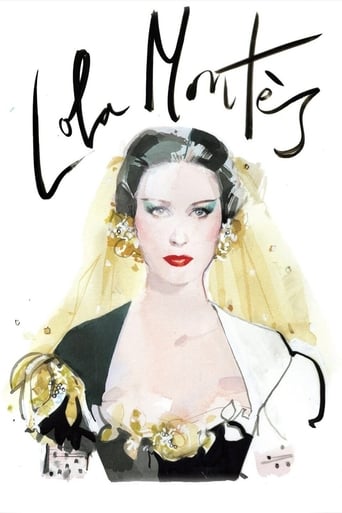
Lola Montès (1955)
Lola Montes, previously a great adventuress, is reduced to being the attraction of a circus after having been the lover of various important men.
- Data lansării
- 1955-12-23
- TMDB
- 6.9 / 10 (157)
- Durată
- 1 h 56 min
- Genuri
- Dramă, Romantic
- Regizor
- Max Ophüls
Distribuție
- Martine Carol — Lola Montes
- Peter Ustinov — Circus Master
- Adolf Wohlbrück — Ludwig I, King of Bavaria
- Henri Guisol — Horseman Maurice
- Lise Delamare — Mrs. Craigie, Lola's Mother
- Paulette Dubost — Josephine, the Maid
- Oskar Werner — Student
- Jean Galland — Private Secretary
- Will Quadflieg — Franz Liszt
- Héléna Manson — Lieutenant James' Sister
- Germaine Delbat — Stewardess
- Carl Esmond — Doctor
Curiozități
Lola Montès is a 1955 historical romance film, and the last completed film of director Max Ophüls. Based on Cécil Saint-Laurent's novel La vie extraordinaire de Lola Montès, the film depicts the life of Irish dancer and courtesan Lola Montez (1821–1861), portrayed by Martine Carol, and tells the story of her many notorious affairs, most notably those with Franz Liszt and Ludwig I of Bavaria. A co-production between France and West Germany, the dialogue is mostly in French and German, with a few English-language sequences.
Production
Lola Montès was planned as a major project to put the theory of European film into practice. Therefore, it was shot in French, German, and English. Ophüls was initially critical of the material, but, after studying Lola Montez's biography, he began to work on the script, planning to make a black-and-white film.
The production companies expected the film to be a success right from the start, and cast it with top-class actors. Martine Carol, a French sex symbol in the 1950s, was hired in September 1954, and received a fee of around 350,000 marks; Anton Walbrook's fee was 100,000 marks.
As CinemaScope films were becoming increasingly popular in the mid-1950s, it was also decided that this "prestige project" would be filmed in the then-new recording format. This decision resulted in further changes to the script, which ultimately also meant high costs for contract extensions for the actors, some of whom did not experience a single day of filming during their first contract period.
The first day of shooting took place in mid-February 1955. The shooting locations included Paris, Nice, Schloss Weißenstein in Pommersfelden, Bamberg, and Bavaria Studios in Munich.
Since, in return for agreeing to shoot in CinemaScope, Ophüls obtained the assurance that "all technical and artistic resources would be made available to him", the film's cost rose to unprecedented heights for the time. Paths were artificially colored to maintain the film's ingenious color concept; for a shot in which snow was needed, the set was taken to the High Tauern; and costumes had to be reworked when the scene of Ludwig's parade at the M…
Citește pe Wikipedia · Text din Wikipedia, CC BY-SA 4.0. Date din Wikidata.
Recomandate
- One from the Heart 1982 · ★ 6.0
- Bay of Angels 1963 · ★ 6.7
- Inimi 2006 · ★ 6.4
- Itinerary of a Spoiled Child 1988 · ★ 7.2
- Ice Castles 1978 · ★ 7.4
- Secretul: Îndrăznește să visezi 2020 · ★ 7.4
- Prima iubire 2009 · ★ 6.6
- The Great Ziegfeld 1936 · ★ 6.2
- Mata Hari 1931 · ★ 6.2
- Amanții secolului 1999 · ★ 5.9
- Vârsta inocenței 1993 · ★ 7.0
- Loulou 1980 · ★ 6.2