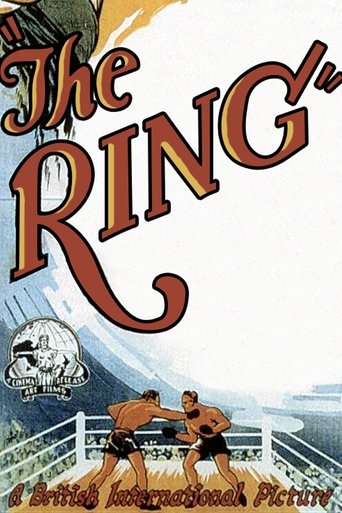
The Ring (1927)
Two boxers compete for the love of a woman.
Both Jack Sander and Bob Corby are boxers in love with Mabel. Jack and Mabel wed, but their marriage is flat. The young wife looks to Bob for comfort.
- Date of release
- 1927-09-28
- TMDB
- 5.9 / 10 (120)
- Runtime
- 1h 56m
- Genres
- Drama, Romance
- Director
- Alfred Hitchcock
Casting
- Carl Brisson — 'One Round' Jack Sander
- Lillian Hall-Davis — Mabel
- Ian Hunter — Bob Corby
- Forrester Harvey — The Promoter
- Harry Terry — The Showman
- Gordon Harker — Jack's Trainer
- Clare Greet — Fortune Teller (uncredited)
- Tom Helmore — Spectator (uncredited)
- Alfred Hitchcock — Man-Dipping Attraction Worker (uncredited)
Interesting facts
The Ring is a 1927 British silent romance film written and directed by Alfred Hitchcock and starring Carl Brisson, Lillian Hall-Davis and Ian Hunter. Hitchcock based it on his frequent visits to the stadium club at 85 High Holborn, owned by Fred Howard.
Production
The film was made at Elstree Studios by the newly established British International Pictures, which emerged as one of the two British major studios during the late 1920s and began hiring leading directors from Britain and abroad. It was Hitchcock's first film for the company after joining from Gainsborough Pictures. It was also the first film to be released by the company.
Hitchcock was 28 years old when he directed The Ring, and this was the young filmmaker's fourth film. Hitchcock regularly attended boxing matches in London where he lived, and he was struck by the fact that a good number of the spectators appeared to be from good backgrounds and dressed in white. He also noticed that fighters were sprinkled with champagne at the end of each round. These details persuaded Hitchcock to start work on The Ring.
After directing Downhill and Easy Virtue, two stage adaptations for the Gainsborough company, Hitchcock was frustrated and jumped at the chance to develop an idea of his own. The Ring is commonly described as Hitchcock's only original screenplay although it actually had input from at least Eliot Stannard, who wrote all of Hitchcock's other silent films.
The film was considered a major technical work by François Truffaut in the 1966 book Hitchcock/Truffaut, and by Claude Chabrol and Éric Rohmer in their book about Hitchcock. It features use of the Schüfftan process to simulate a large audience in climactic scenes set in the Royal Albert Hall. Hitchcock returned to this technique years later in films like The Man Who Knew Too Much in its Royal Albert Hall sequence.
Read on Wikipedia · Text from Wikipedia, CC BY-SA 4.0. Data from Wikidata.
Recommended
- Sunrise: A Song of Two Humans 1927 · ★ 7.8
- Wings 1927 · ★ 7.2
- They Won't Believe Me 1947 · ★ 6.6
- Match Point 2005 · ★ 7.4
- The Crowd 1928 · ★ 7.6
- Blood and Sand 1941 · ★ 6.5
- Flesh and the Devil 1926 · ★ 7.2
- The Set-Up 1949 · ★ 7.4
- Strangers When We Meet 1960 · ★ 6.4
- Champion 1949 · ★ 6.7
- The Sleeping Dictionary 2003 · ★ 6.6
- The Magic of Ordinary Days 2005 · ★ 7.6