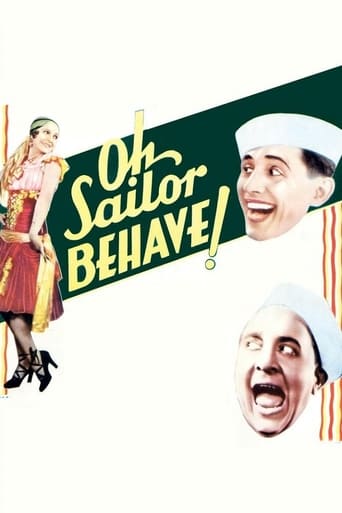
Oh, Sailor, Behave! (1930)
Based on the farcical stage play written by Pulitzer Prize-winning* writer Elmer Rice, Oh, Sailor Behave! is a movie Musical with a split personality. Nanette Dodge (Irene Delroy) falls for newspaper reporter Charlie Carroll (Charles King) who is on assignment in Venice to land an interview with Romanian General Skulany (Noah Beery). Our couple is split apart by a pair of storylines - Nanette tries to woo a Russian prince (Lowell Sherman) who is blackmailing her sister, while Charlie, following a lead to the general, finds himself Romantically involved with Kunegundi (Vivien Oakland), "the general's favorite."
- 개봉일
- 1930-08-15
- TMDB
- 6.0 / 10 (4)
- 상영 시간(분)
- 1시간 10분
- 장르
- 음악, 코미디
- 감독
- Archie Mayo
출연진
- Irene Delroy — Nanette Dodge
- Ole Olsen — Simon
- Chic Johnson — Peter
- Lowell Sherman — Prince Kosloff
- Vivien Oakland — Kunegundi
- Noah Beery — Romanian General
- Lotti Loder — Louisa
- Charles Judels — De Medici
- Lawrence Grant — Von Klaus
- Gino Corrado — Stephan
- Hallam Cooley
- Charles King — Charlie Carroll
흥미로운 사실
Oh, Sailor, Behave! is a 1930 American pre-Code musical comedy film produced and released by Warner Bros. Pictures, and based on the play See Naples and Die, written by Elmer Rice. The film was originally intended to be entirely in Technicolor and was advertised as such in movie trade journals. Due to the backlash against musicals, it was apparently released in black-and-white only.
Production background
Charles King recorded three songs for the film for Brunswick Records: Brunswick 4840 (Highway to Heaven/When Love Comes in the Moonlight); Brunswick 4849 (Leave A Little Smile). The other side of Brunswick 4849 featured a song from the aborted MGM revue The March of Time (1930).
This was to be Charles King's last musical movie. He went back to the Broadway stage, since movie audiences had grown tired of musicals, and never returned to the screen.
Due to the public apathy towards musicals, Warner Bros. did not debut this film in the usual prestigious movie theaters. The film was immediately placed in general release with no fanfare.
Comedians Olsen and Johnson were added to the film due to growing public apathy towards serious stage actors such as King and Delroy. The movie was marketed as a comedy film with these comics billed as "America's funniest clowns".
위키백과에서 더 읽기 · 텍스트 출처: 위키백과, CC BY-SA 4.0. 데이터 출처: Wikidata.
추천
- 루이 CK: 오 마이 갓 2013 · ★ 7.6
- 마라가 큰 결정을 해야 해 2019 · ★ 5.9
- Thunderstruck 2012 · ★ 6.2
- 헛소동 2013 · ★ 6.8
- 72시간 2026 · ★ 6.7
- 크리스 락: 킬 더 메신저 2008 · ★ 7.6
- 셰인 길리스: 아름다운 개들 2023 · ★ 7.1
- 가브리엘 이글레시아스: 푹신한 개그맨의 기아 체험 2016 · ★ 7.0
- 수첩 속의 행운 1990 · ★ 6.3
- 애덤 샌들러: 애정 충만 2024 · ★ 6.2
- Adam Sandler: 100% Fresh 2018 · ★ 7.1
- Love Happy 1949 · ★ 5.8