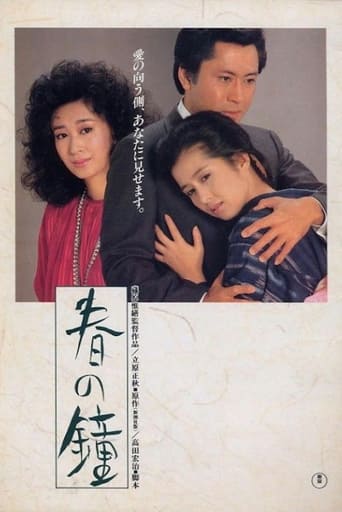
春の鐘 (1985)
Rokuheita Narumi is fascinated by oriental art and works as the director of the Saho Art Museum in Nara. His wife, Noriko, is unable to leave Tokyo, despite his wishes, and the two live separately. Feeling lonely and neglected by her husband, she immerses herself in the depraved life of the city and continues to have a loveless relationship with a doctor, Katsumori. One day, Narumi arrives in Tokyo and learns of Noriko's affair, but he cannot divorce her for the sake of their child, so he devotes himself to his work.
- Erscheinungsdatum
- 1985-11-09
- TMDB
- 7.2 / 10 (4)
- Laufzeit
- 2 Std. 10 Min.
- Genres
- Liebesfilm, Drama
- Regie
- Koreyoshi Kurahara
Besetzung
- Kin'ya Kitaōji — Rokuheita Narumi
- 三田佳子 — Noriko Narumi
- Eiji Okada — Hachiro Ishimoto
- 岸田今日子 — Fusako Ishimoto
- 加賀まりこ — Sanae Ishiwata
- 芦田伸介 — Toichiro Miyake
- 中尾彬 — Maki Katsumori
- 藤田敏八 — Tomio Murata
- Tomoko Naraoka — Katsuko Naganuma
- 白川和子 — Toyoko
- 佐々木すみ江 — Rise Amano
- 中島葵 — Kazuyo
Wissenswertes
Haru no Kane , also known as Spring Bell, is a 1985 Japanese romantic drama film directed by Koreyoshi Kurahara and written by Kôji Takada. It was adapted from a novel of the same name by Masaaki Tachihara, first published in 1978 by Shinchosha. The film's story concerns an extramarital affair and its impact on the marriage of an art museum director and his wife. It stars Kin'ya Kitaōji and Yoshiko Mita in the lead roles. Toho released Haru no Kane theatrically on November 9, 1985, in Japan. Joe Hisaishi, credited onscreen as "Yuzuru Hisaishi", composed the film's score.
Production
Cinematographer Akira Shiizuka and editor Akira Suzuki had worked with director Kurahara on his previous films Antarctica and The Glacier Fox.
The production originally cast Ken Ogata as Rokuheita and Ayumi Ishida as Noriko, but Ogata insisted on "changing the role to a male-oriented film with Narumi [Rokuheita] at the center". Creative disagreements ensued, and the pair dropped out. They were replaced by Kin’ya Kitaōji and Yoshiko Mita, respectively. Mita was persuaded when Kurahara told her, "If you don't appear in this film, I won't do this film."
Haru no Kane originally featured a nude scene with Yūko Kotegawa’s character. She was nervous about the scene, but accepted the role in order to work with Kurahara. However, during editing, Kurahara determined that the scene was too long and cut most of Kotegawa’s nudity from the film.
Auf Wikipedia weiterlesen · Text aus Wikipedia, CC BY-SA 4.0. Daten aus Wikidata.
Empfohlen
- Radiance 2017 · ★ 6.5
- Gabriel's Inferno: Part III 2020 · ★ 8.3
- Gabriel's Inferno 2020 · ★ 8.4
- Love is Blind - Auf den zweiten Blick 2017 · ★ 6.1
- See You Soon 2019 · ★ 5.9
- Love Everlasting 2016 · ★ 7.4
- Time Is Up 2021 · ★ 6.5
- It Feels So Good 2019 · ★ 6.6
- Gabriel's Inferno: Part II 2020 · ★ 8.3
- His Motorbike, Her Island 1986 · ★ 7.7
- Ausweg 2020 · ★ 6.0
- Not Easily Broken - Gib niemals auf! 2009 · ★ 6.3