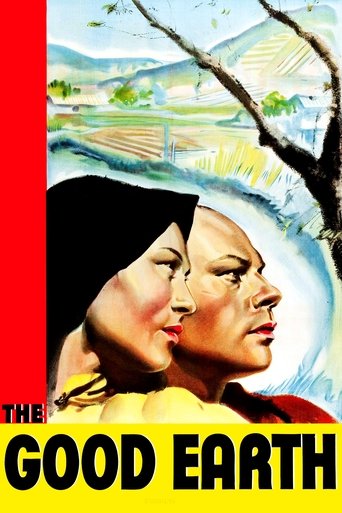
The Good Earth (1937)
China… Land of unrest… Tomorrow they may starve!
China, during the rule of the Qing Dynasty. The arranged marriage between Wang Lung, a humble farmer, and O-Lan, a domestic slave, will endure the many hardships of life over the years; but the temptations of a fragile prosperity will endanger their love and the survival of their entire family.
- Date of release
- 1937-06-02
- TMDB
- 6.3 / 10 (81)
- Runtime
- 2h 19m
- Genres
- Drama, History, Romance
- Director
- Sidney Franklin
Casting
- Paul Muni — Wang
- Luise Rainer — O-Lan
- Walter Connolly — Uncle
- Tilly Losch — Lotus
- Charley Grapewin — Old Father
- Jessie Ralph — Cuckoo
- Soo Yong — Aunt
- Keye Luke — Elder Son
- Roland Lui — Younger Son
- Suzanna Kim — Little Fool
- Ching Wah Lee — Ching
- Harold Huber — Cousin
Interesting facts
- Based on: The Good Earth
- Filmed in: Los Angeles, Beijing, and Utah
- Awards: 3 · Nominations: 5. Including: Academy Award for Best Actress; Academy Award for Best Cinematography; National Board of Review: Top Ten Films
The Good Earth is a 1937 American drama film about Chinese farmers who struggle to survive. It was adapted by Talbot Jennings, Tess Slesinger, and Claudine West from the 1932 play by Owen Davis and Donald Davis, which was in itself based on the 1931 novel of the same name by Nobel Prize-winning author Pearl S. Buck. The film was directed by Sidney Franklin, with uncredited contributions by Victor Fleming and Gustav Machaty.
Production
The film's budget was $2.8 million (equivalent to $49,600,000 in 2024) and took three years to make. The film shoot itself took a year and five months and included 5,500 extras. A 500-acre (200-hectare) farm in Porter Ranch, California, was transformed into a replica of Chinese farmland for the film.
The movie script was more sympathetic to China than the novel had been. Wang Lung's son was now a representative of modern China who goes to university and leads the villagers. The family is a wholesome affectionate unit, even the uncle who in the novel exploits Wang Lung, and the sexual aspect of Lotus is played down.
Pearl Buck intended the film to be cast with all Chinese or Chinese-American actors. Irving Thalberg also envisioned casting only Chinese actors, but had to concede that American audiences were not ready for such a film. According to Variety, Anna May Wong had been suggested for the role of O-Lan, but the Hays Code anti-miscegenation rules required Paul Muni's character's wife to be played by a white actress.
When MGM inquired into the possibility of making the film in China, the Chinese government was divided on how to respond. Initial hostility derived from resentment of the novel, which critics charged focused only on the perceived backwardness of the country, while some government officials hoped to have control which would be gone if the film work was done outside China.
The film's 1936 production lasted from February 28 to July 23. Thalberg died on September 14, four-and-a-half months before its Los Angeles premiere on January 29, 1937. The film credits stated that this was his "last great achievement". Original prints of the film were presented in sepiatone.
Read on Wikipedia · Text from Wikipedia, CC BY-SA 4.0. Data from Wikidata.
Recommended
- The Sleeping Dictionary 2003 · ★ 6.6
- Far from the Madding Crowd 1967 · ★ 6.9
- Wuthering Heights 1939 · ★ 7.2
- Wuthering Heights 1970 · ★ 6.4
- Out of Africa 1985 · ★ 7.2
- The Secret: Dare to Dream 2020 · ★ 7.4
- Pride & Prejudice 2005 · ★ 8.1
- Mayerling 1968 · ★ 6.2
- The Go-Between 1971 · ★ 6.8
- Sunrise: A Song of Two Humans 1927 · ★ 7.8
- Sense and Sensibility 1995 · ★ 7.4
- The Lost Husband 2020 · ★ 6.7