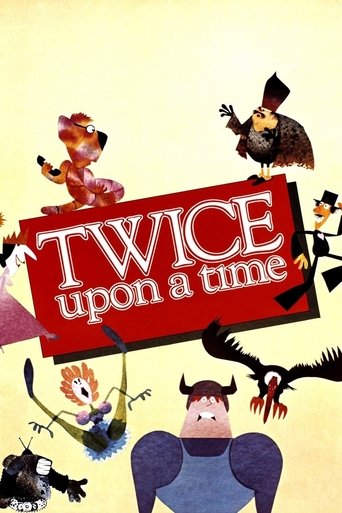
Twice Upon a Time (1983)
The funniest heroes you'll ever meet... They came. They saw. They screwed up.
In the world of the Murkworks where nightmares are made, the evil Synonamess Botch hatches a scheme to make non-stop nightmares. Only Ralph and Mumford, misfits from the cheery land of Frivoli where good dreams are made, can stop him.
- Date of release
- 1983-08-05
- TMDB
- 6.6 / 10 (27)
- Runtime
- 1h 13m
- Genres
- Animation, Comedy, Adventure, Fantasy
- Director
- John Korty, Charles Swenson
Casting
- Lorenzo Music — Ralph, the All-Purpose Animal (voice)
- Judith Kahan — The Fairy Godmother (voice)
- Marshall Efron — Synonamess Botch (voice)
- James Cranna — Rod Rescueman / Scuzzbopper / Foreman (voice)
- Julie Payne — Flora Fauna (voice)
- Hamilton Camp — Greensleeves (voice)
- Paul Frees — Narrator / Chef of State / Judges / Bailiff (voice)
- Gillian Gould — Rusher of Din: Sleeper
- Geraldine Green — Rusher of Din: Sleeper
- Larry Green — Rusher of Din: Sleeper
- William Hall — Rusher of Din: Sleeper
- David Korty — Rusher of Din: Sleeper
Interesting facts
- Budget: $3M
Twice Upon a Time is a 1983 American animated adventure-fantasy-comedy film co-directed by John Korty and Charles Swenson from a screenplay by Korty, Swenson, Suella Kennedy, and Bill Couturié. The first animated film produced by George Lucas, it uses a form of cut-out animation which the filmmakers called "Lumage", involving prefabricated cut-out elements that the animators moved on a light table, emulating stained glass. The film features improvised dialogue and interspersed live-action footage and background stills.
Production
John Korty developed the "Lumage" animation process over twenty years, providing animated segments for projects such as The Electric Company and Sesame Street. Lumage was a type of stop motion animation in which cut-out shapes are photographed on large fields of glass lit primarily from below, as opposed to the standard 12-inch fields used in cel animation.
There were many different versions of this movie because the producers could only hire improvisational comedians.
In one version, Greensleeves is not kidnapped at the beginning. Ralph and Mumford release and lose the spring, then stop by a bar where they meet Greensleeves, who urges the boys to get the spring. Later, the spring escapes the vultures and finds its way to Greenie, who is then asked to put the spring back in the cosmic clock. At this point, the vultures swoop in and capture Greensleeves and the spring.
Another version of the movie included Synonymess Botch swearing throughout the film. From the outset, director John Korty did not want to use the dialogue of the original script, but actor Marshall Efron thought his lines were perfect and played up the raunchier aspects of his character. Some lines were selected by producer Bill Couturié as he felt it would help the film appeal to older audiences.
Read on Wikipedia · Text from Wikipedia, CC BY-SA 4.0. Data from Wikidata.
Recommended
- Bilal: A New Breed of Hero 2016 · ★ 6.8
- Batman: The Doom That Came to Gotham 2023 · ★ 6.7
- Wizards 1977 · ★ 6.2
- Under Wraps 2021 · ★ 6.8
- Fire and Ice 1983 · ★ 6.7
- Justice League: Doom 2012 · ★ 7.4
- Willow 1988 · ★ 7.0
- Pirates of the Caribbean: Dead Man's Chest 2006 · ★ 7.4
- The Golden Child 1986 · ★ 5.9
- Justice League: Crisis on Two Earths 2010 · ★ 7.3
- Love and Monsters 2020 · ★ 7.3
- Miss Peregrine's Home for Peculiar Children 2016 · ★ 6.8