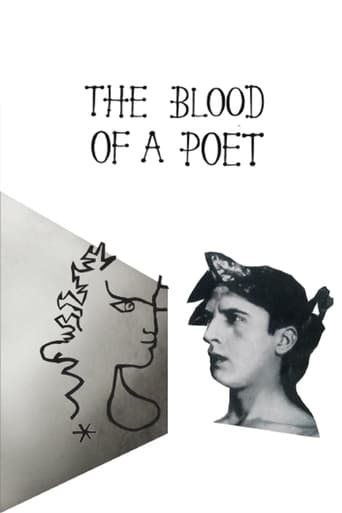
The Blood of a Poet (1932)
Le Sang d'un poète
In a poet’s room, an armless statue abruptly comes to life. It invites the poet to step through a mirror and to discover another world. Strange places and characters present themselves to him. The poet tears himself away from these twisted fascinations and returns, with some difficulty, to his room.
- Date of release
- 1932-01-20
- TMDB
- 7.0 / 10 (205)
- Runtime
- 55m
- Genres
- Fantasy
- Director
- Jean Cocteau
- Collection
- The Orphic Trilogy
Casting
- Enrique Rivero — Poet
- Elizabeth Lee Miller — Statue
- Pauline Carton — The child trainer
- Odette Talazac
- Jean Desbordes — Louis XV Friend
- Fernand Dichamps
- Lucien Jager — A spectator in a box
- Féral Benga — Black Angel
- Barbette — A spectator
- Jean Cocteau — Bit Part (uncredited)
Interesting facts
The Blood of a Poet is a 1932 avant-garde film directed by Jean Cocteau, financed by Charles de Noailles and starring Enrique Riveros, a Chilean actor who had a successful career in European films. Photographer Lee Miller made her only film appearance in this movie, which features an appearance by the famed aerialist Barbette. It is the first part of The Orphic Trilogy, which is continued in Orphée (1950) and concludes with Testament of Orpheus (1960).
Production and film
The Blood of a Poet was made during a time of transition to narrative sound film and still made use of written text such as the opening words: "Every poem is a coat of arms. It must be deciphered". The film is considered, along with The Golden Age (1930), one of two French films released at the end of this first phase of avant-garde film-making that continue to develop the model presented by Chien Andalou:
...elements of narrative and acting arouse the spectator's psychological participation in plot or scene while at the same time distancing the viewer by disallowing empathy, meaning and closure; an image of the disassociated sensibility or 'double consciousness' praised by Surrealism in its critique of naturalism
The film is a blend of Cocteau's classical aesthetics and the Baroque stylings of Surrealism. Cocteau's voice satirically explores his character's obsession with fame and death: "Those who smash statues should beware of becoming one". Dissolution of personal identity is presented in contrast with Western emphasis on stability and repetition.
The Blood of a Poet was funded by Charles, Vicomte de Noailles, who gave Cocteau 1 million francs to make it. Cocteau invited the Vicomte and his wife Marie-Laure de Noailles, along with several of their friends, to appear in a scene as a theatre party. In the scene, they talked among themselves and, on cue, began applauding.
The film is not considered to be anti-theocratic in the way of Luis Buñuel's L'Age d'Or, but the film's protagonist does explore such varied topics as magic, archaic art, China, opium and transvestism before dying while playing cards in front of an indifferent audience.
Read on Wikipedia · Text from Wikipedia, CC BY-SA 4.0. Data from Wikidata.
Recommended
- Legend 1985 · ★ 6.3
- A Midsummer Night's Dream 1999 · ★ 6.4
- The King and the Mockingbird 1980 · ★ 7.8
- Somewhere in Time 1980 · ★ 7.5
- Peter Ibbetson 1935 · ★ 7.0
- The Painting 2011 · ★ 7.0
- The Princess Bride 1987 · ★ 7.7
- Edward Scissorhands 1990 · ★ 7.7
- MirrorMask 2005 · ★ 6.5
- The Bishop's Wife 1947 · ★ 7.1
- My Winnipeg 2008 · ★ 6.9
- Unicorn Store 2017 · ★ 5.9