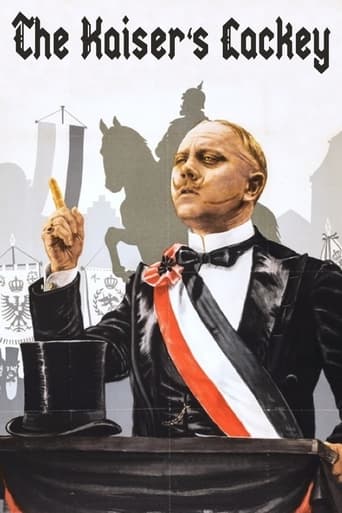
The Kaiser's Lackey (1951)
Der Untertan
Diederich Heßling is scared of everything and everyone. But as he grows up, he comes to realize that he has to offer his services to the powers-that-be if he wants to wield power himself. His life motto now runs: bow to those at the top and tread on those below. In this way, he always succeeds: as a student in a duel-fighting student fraternity and as a businessman in a paper factory. He cajoles the obese district administrative president Von Wulkow and wins his favor. He slanders his financial rivals and hatches a plot with the social democrats in the town council. On his honeymoon with his rich wife Guste, he finally finds a chance to do his beloved Kaiser a favor. And when a memorial to the Kaiser is unveiled in the town where Diederich lives and works, he delivers the address. He stands behind the lectern in the pouring rain, saluting his Kaiser. The crowd is dispersed. Everything is laid in ruins...
- Date of release
- 1951-08-31
- TMDB
- 6.7 / 10 (25)
- Runtime
- 1h 49m
- Genres
- Drama, History, Comedy
- Director
- Wolfgang Staudte
Casting
- Werner Peters — Diederich Heßling
- Paul Esser — Regierungspräsident von Wulckow
- Blandine Ebinger — Frau von Wulckow
- Renate Fischer — Guste Daimchen
- Carola Braunbock — Emmi Heßling
- Emmy Burg — Magda Heßling
- Sabine Thalbach — Agnes Göppel
- Friedel Nowack — Mrs. Göpel
- Friedrich Maurer — Göpel
- Erich Nadler — Father Heßling
- Gertrud Bergmann — Mother Heßling
- Ernst Legal — Zillich
Interesting facts
- Based on: Der Untertan
The Kaiser's Lackey is a 1951 East German film directed by Wolfgang Staudte, based on Heinrich Mann's 1918 satirical novel by the same name.
Production
Heinrich Mann's satirical novel der Untertan, with its attack on Wilhelmine conservatism, was held in high esteem by the Socialist Unity Party of Germany; it was entered into the schools' curriculum, and the cultural establishment viewed it as vital for re-educating the populace.
Director Wolfgang Staudte first suggested adapting the novel to the screen in 1946; while visiting London for the premiere of The Murderers Are Among Us, he was approached by a local critic, Hans H. Wollenberg, who told him he should direct a picture based on the book. After returning to East Berlin, Staudte discussed the idea with officials from the DEFA studio, who approved of it.
During 1949, as Mann was elected President of the Academy of the Arts and planned his emigration to the German Democratic Republic, DEFA concluded to resume the project. On 23 September 1949, a letter from the studio requesting his approval to make the film was sent to Mann, whose positive reply reached East Germany on 24 October.
Staudte was not the first chosen to direct der Untertan: Falk Harnack and even Erich von Stroheim were considered by the studio. He received the nomination after rejecting making The Axe of Wandsbek, which was turned on to Harnack. It was his first full-length adaptation of a literary work.
Principal photography commenced in the Babelsberg Studios on 1 March 1951. While working on the film, Staudte was almost completely exempt from interference by state censors: the establishment regarded the picture as highly important, and did not subject it to the demands of the Anti-formalism campaign which began in the GDR at the time.
Read on Wikipedia · Text from Wikipedia, CC BY-SA 4.0. Data from Wikidata.
Recommended
- Mr. Turner 2014 · ★ 6.6
- Berlin Blues 2003 · ★ 6.8
- Mary 2024 · ★ 6.3
- Munich - The Edge of War 2021 · ★ 6.9
- Goodbye Berlin 2016 · ★ 6.7
- Rose 2026 · ★ 7.7
- Julia 1977 · ★ 6.5
- Worth 2021 · ★ 6.7
- SubUrbia 1997 · ★ 6.2
- The Immortal Life of Henrietta Lacks 2017 · ★ 6.3
- All the Way 2016 · ★ 6.7
- The Tasters 2025 · ★ 6.7