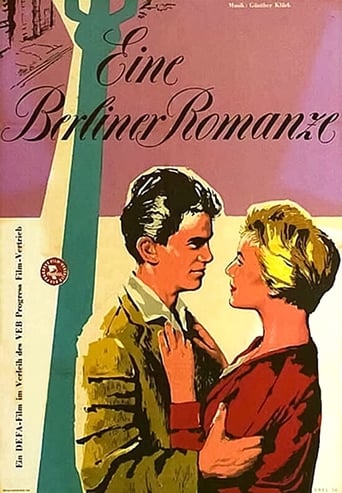
Eine Berliner Romanze (1956)
Mid-1950s Berlin, before the building of the Wall. Uschi, a salesgirl and aspiring fashion model from the East, is attracted to Hans, from the West. But she also loves the bright shop windows in his part of the city. The flashiness of this new world soon evaporates, however, when Hans loses his job.
- Data di uscita
- 1956-05-16
- TMDB
- 5.8 / 10 (9)
- Durata
- 1 h 21 min
- Generi
- Dramma, Romance
- Regista
- Gerhard Klein
Cast
- Annekathrin Bürger — Uschi
- Ulrich Thein — Hans
- Erika Dunkelmann — Uschis Mutter
- Marga Legal — Hans' Mutter
- Horst Kube — Max
- Uwe-Jens Pape
- Erich Franz
- Hartmut Reck
- Karl Kendzia
- Eckart Friedrichson
- Paul Pfingst
- Ernst-Georg Schwill
Curiosità
A Berlin Romance is a 1956 East German neo-realist romantic drama film about youth urban life in the divided city of Berlin, directed by Gerhard Klein. It was produced by the DEFA film company. It stars Annekathrin Bürger, Ulrich Thein and Uwe-Jens Pape. The script was written by Wolfgang Kohlhaase with a score composed by Günter Klück. The film was the second collaboration between Klein and Kohlhaase; the first was Alarm in the Circus, released in 1954 and third came in 1957 with Berlin - Ecke Schönhauser. These films were noted for their strong criticism of consumer culture in Berlin after World War II and the Americanization of the capital and are amongst DEFA's best known films.
Production
Seeking to infuse the film with a strong sense of realism, Cinematographer Wolf Göthe used techniques such as wide-angle lenses, extensive location work and high-speed film.
The film, inspired by Italian neo-realism, is a poignant insight into the difference in socio-economic customs and general domestic life which divided the city of Berlin during this period. Through the protagonist, Uschi, the audience is able to understand the feelings and emotions felt by many at the time.
The film is one of the strongest critiques of consumer culture in Germany in the 1950s in the aftermath of World War II.Alexander Stephan, in his book, Americanization and Anti-Americanism. The German Encounter with American Culture After 1945, argues that connection between bourgeois and individualism and the ethos of socialism became increasingly politicized after the Second World War.
He argues that the film, rather than being an advert for West Berlin, is in fact a critique of Americanization in the western side of the capital, and that American masculine influences weakened traditional senses of authority in both public and domestic life, and says, "In typical neo-realist fashion, Klein and Kohlhaase evoke the Americanization of East Berlin through their relationship [...]." The film, in this context, can therefore be seen a…
Leggi su Wikipedia · Testo da Wikipedia, CC BY-SA 4.0. Dati da Wikidata.
Consigliati
- Il cielo sopra Berlino 1987 · ★ 7.8
- La donna di Parigi 1923 · ★ 6.7
- Bobby il cucciolo di Edimburgo 1961 · ★ 6.9
- Innamorarsi 1984 · ★ 6.6
- Quiller memorandum 1966 · ★ 5.9
- The Magic of Ordinary Days 2005 · ★ 7.5
- Nessuno mi crederà 1947 · ★ 6.6
- Come eravamo 1973 · ★ 7.0
- Gli assassini sono tra noi 1946 · ★ 6.8
- Germania anno zero 1948 · ★ 7.6
- L'amore in città 1953 · ★ 6.5
- Martin Eden 2019 · ★ 7.0