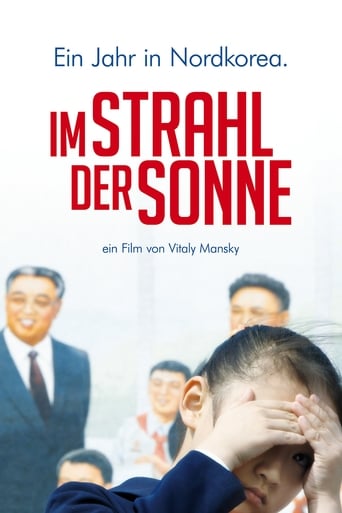
Im Strahl der Sonne (2015)
Over the course of one year, this film follows the life of an ordinary Pyongyang family whose daughter was chosen to take part in Day of the Shining Star (Kim Jong-il's birthday) celebration. While North Korean government wanted a propaganda film, the director kept on filming between the scripted scenes. The ritualized explosions of color and joy contrast sharply with pale everyday reality, which is not particularly terrible, but rather quite surreal.
- Data di uscita
- 2015-10-30
- TMDB
- 7.2 / 10 (136)
- Durata
- 1 h 50 min
- Generi
- Documentario
- Regista
- Виталий Манский
Cast
- 리진미 — Herself
- Yu-yong — Herself
- Hye-yong — Herself
- Oh-gyong — Herself
- Lim Soo-yong — Herself
- Choi Song-min — Herself
- Su-yong — Herself
- 김정은 — Himself
Curiosità
- Budget: 390K €
- Girato a: Pyongyang
- Premi: 1 · Candidature: 0. Tra cui: Golden Kingfisher Award for the best documentary
Under the Sun is a 2015 documentary film directed by Vitaly Mansky. It depicts a year in the life of a family in Pyongyang, North Korea, as their daughter, Zin-mi, prepares to join the Korean Children's Union on the Day of the Shining Star.
Production
Mansky conceived the project as a film set in a country similar to the Soviet Union. He envisioned it to be "a time machine" to the Soviet Union under Stalin, and a means to better understand his country's history. Prior to the project, Mansky stated that he had not previously visited North Korea and "only knew what most of us knew".
Russian company Vertov.Real Cinema began negotiations to secure permission to shoot a film in North Korea in 2013. The negotiations with the North Korean Ministry of Culture lasted two years. The project was finalized as a portrait of an 8-year-old school girl named Zin-mi and her family in Pyongyang, focusing on her preparing to join the Korean Children's Union on the Day of the Shining Star (Kim Jong Il's birthday).
After arriving in North Korea, Mansky was not permitted to go anywhere by himself, and could not directly speak with any of his subjects. Realizing that the North Korean government intended to make a propaganda film, Mansky decided to keep the cameras rolling between shots. The film crew captured footage of North Korean handlers staging scenes and instructing characters on how to behave and what dialogue to say.
The film was initially financed by Vertov.Real Cinema. Later, funding was provided by Saxonia Entertainment and MDR from Germany, and Hypermarket Films from the Czech Republic. Per the contract with the North Korean government, the North Korean Ministry of Culture received credit as a co-producer, although they did not provide any financial support for the film.
North Korea permitted only Mansky, cinematographer Alexandra Ivanova, and a sound assistant to visit the country. Unknown to North Korean authorities, Mansky hired a Russian translator who was fluent in Korean, but had no experience in sound recording, to act as the sound assistant, explaining: "She [the translator] was our spy.
Leggi su Wikipedia · Testo da Wikipedia, CC BY-SA 4.0. Dati da Wikidata.
Consigliati
- Cuore di un cane 2015 · ★ 6.5
- Deliver Us from Evil 2006 · ★ 7.2
- Cuba and the Cameraman 2017 · ★ 7.5
- U.S.A. contro John Lennon 2006 · ★ 6.6
- Chávez - L'ultimo comandante 2009 · ★ 6.1
- Capital in the Twenty-First Century 2019 · ★ 6.5
- The Class of ‘92 2013 · ★ 7.1
- Joan Didion: il centro non reggerà 2017 · ★ 7.4
- Essere James Bond 2021 · ★ 7.8
- 14 vette: scalate ai limiti del possibile 2021 · ★ 7.3
- The War Room 1993 · ★ 6.8
- Hawking - Questa è la mia vita 2013 · ★ 7.6