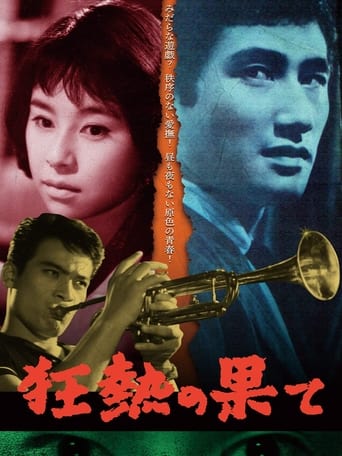
狂熱の果て (1961)
A leading postwar Japanese film critic and theorist who co-founded the seminal film magazine Eiga Hihyo (Film Criticism) in 1957, Eizo Yamagiwa made his directorial debut with this independent feature—long thought lost until a negative was recently discovered—about a group of idle bourgeois students known as the “Roppongi Tribe” (Roppongi zoku). Depicting the resignation and nihilism of the postwar generation in the years following the Anpo Treaty conflicts through a coming-of-age narrative, Yamagiwa offers sharp criticism of the prevalent characterizations of Japan's new youth offered by Nikkatsu's taiyozoku (“Sun Tribe”) films and the New Wave at large.
- Erscheinungsdatum
- 1961-11-01
- Laufzeit
- 1 Std. 18 Min.
- Regie
- 山際永三
Besetzung
- 松原光二 — Kenji Nomura
- Mitsuko Sawamura — Yuri
- Terumi Hoshi — Michi Makino
- 藤木孝 — Yoji Nakaoka
- 柏木優子 — Akemi
- 松浦浪路 — Noriko
- 利根はる恵 — Michi's mother
- 宮田文子 — Nurse
- Masami Akimoto — Akiko
- 中村彰 — Michi's father
- 鳴門洋二
- Hiroshi Inoue — Singer
Empfohlen
- Imprint 2006 · ★ 6.8
- Der Mohnblumenberg 2011 · ★ 7.5
- Tokio Dekadenz 1992 · ★ 6.0
- Engel der Verlorenen 1948 · ★ 7.6
- Jin-Roh - Die Wolfsbrigade 1999 · ★ 7.4
- Double Suicide 1969 · ★ 7.0
- Golden Kamuy 2024 · ★ 7.0
- Enter the Void 2010 · ★ 7.3
- Demon Slayer: Kimetsu no Yaiba - Mugen Train 2020 · ★ 8.2
- Das Licht der Illusion 1995 · ★ 7.5
- Tokio-Story 1955 · ★ 6.2
- Road to Ninja: Naruto the Movie 2012 · ★ 7.4