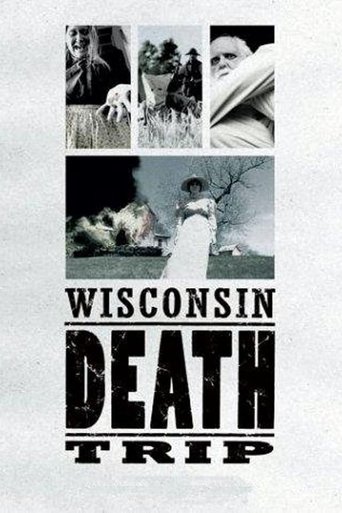
Wisconsin Death Trip (1999)
„Wisconsin Death Trip“ ist eine ebenso intime und schockierende wie bisweilen urkomische Schilderung der Katastrophen, die eine Kleinstadt in Wisconsin im letzten Jahrzehnt des 19. Jahrhunderts heimsuchten. Der Film basiert auf dem gleichnamigen Buch von Michael Lesy.
- Erscheinungsdatum
- 1999-09-05
- TMDB
- 5.7 / 10 (29)
- Laufzeit
- 1 Std. 16 Min.
- Genres
- Dokumentarfilm, Krimi
- Regie
- James Marsh
Besetzung
- Ian Holm — Narrator (voice)
- Marcus Monroe — Young Anderson
- Marilyn White — Pauline L'Allemand
- John Baltes — Undertaker
- Molly Nikki Anderson — Mrs. Larson
- Brittany Haydock — Baptized Girl
- Eddie Kunz — Abandoned Boy
- Steven Strobel — Union Man
Wissenswertes
Wisconsin Death Trip is a 1999 docudrama film written for the screen and directed by James Marsh, based on the 1973 historical nonfiction book of the same name by Michael Lesy. The film dramatizes a series of macabre incidents that took place in and around Black River Falls, Wisconsin in the late-19th century. It utilizes silent black-and-white reenactment footage contrasted with contemporary color footage of the region, along with voice-over narration by Sir Ian Holm, orating contemporaneous newspaper articles written about the occurrences. Music featured in the film includes DJ Shadow and John Cale.
Production
Documentary filmmaker James Marsh began developing a docudrama film adaptation of Michael Lesy's 1973 nonfiction book of the same name after moving to the United States in 1995. Prior to this, Marsh had produced works for the BBC series Arena. The BBC provided seed money to help finance Wisconsin Death Trip, and Marsh also acquired funding from a Norwegian American immigrant fund in the United States.
Marsh met with New York-based film producer Maureen Ryan, who agreed to produce the feature despite it having "no obvious commercial prospects and a tiny budget provided by the BBC". According to Marsh, the film took approximately four years to develop between its initial production and filming.
By Marsh's account, Wisconsin Death Trip was a protracted process: "I did it in episodes. I'd shoot in one season. And then reflect on what I'd done and go shoot some more the next season. Then run out of money. Then go back again." To shoot the reenactment footage featured in the film, Marsh hired Danish cinematographer Eigil Bryld, with whom his wife had attended school in Denmark.
Marsh took advantage of numerous preserved historical homes and other sites in Wisconsin to shoot the film, as they contained "historically correct, sometimes priceless antiques" that matched the necessary period setting. He stated that the crew was granted permission to shoot at "almost every historical site that we requested," and that they offered a nominal donation in exchange for the historical site managers' allowing them to film there.
Auf Wikipedia weiterlesen · Text aus Wikipedia, CC BY-SA 4.0. Daten aus Wikidata.
Empfohlen
- Stolen: Der große Diamantenraub in Antwerpen 2025 · ★ 7.1
- Erlöse uns von dem Bösen 2006 · ★ 7.2
- Beltracchi - Die Kunst der Fälschung 2014 · ★ 7.1
- Naqoyqatsi 2002 · ★ 6.2
- Unser Leben 2011 · ★ 7.5
- Downloaded 2013 · ★ 6.5
- The Matrix Recalibrated 2004 · ★ 6.9
- What We Left Behind: Looking Back at Star Trek: Deep Space Nine 2018 · ★ 7.2
- American Boy: A Profile of Steven Prince 1978 · ★ 6.7
- Necessary Evil: Super-Villains of DC Comics 2013 · ★ 6.8
- Der Kristall ruft - Das Making-of zu "Der dunkle Kristall: Ära des Widerstands" 2019 · ★ 7.5
- Das Kapital im 21. Jahrhundert 2019 · ★ 6.5