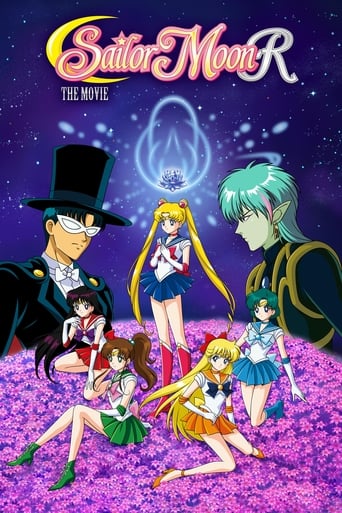
Sailor Moon R: The Movie - The Promise of the Rose (1993)
劇場版 美少女戦士セーラームーンR
The Future Depends On Scout Power!
While enjoying the flower gardens, Sailor Moon and friends encounter an old childhood friend of Mamoru's: an alien! He's come back to give Mamoru a special flower but doesn't like Usagi and the rest of the planet's inhabitants. Sailor Moon must defend the earth from the evil Kisenian Flower he's brought back... before the evil vines and blossoms overrun the planet!
- Date of release
- 1993-12-05
- TMDB
- 7.8 / 10 (193)
- Runtime
- 1h 1m
- Genres
- Animation, Action, Fantasy
- Director
- Kunihiko Ikuhara
- Collection
- Sailor Moon Collection
Casting
- Kotono Mitsuishi — Usagi Tsukino / Sailor Moon (voice)
- Toru Furuya — Mamoru Chiba / Tuxedo Mask (voice)
- Michie Tomizawa — Rei Hino / Sailor Mars (voice)
- Aya Hisakawa — Ami Mizuno / Sailor Mercury (voice)
- Emi Shinohara — Makoto Kino / Sailor Jupiter (voice)
- Rica Fukami — Minako Aino / Sailor Venus (voice)
- Keiko Han — Luna (voice)
- Yasuhiro Takato — Artemis (voice)
- Kae Araki — Chibiusa (voice)
- Wakana Yamazaki — Flower Youma Gurishina (voice)
- Hiromi Nishikawa — Flower Youma Kanpanyura (voice)
- Megumi Ogata — Young Mamoru (voice)
Interesting facts
- Based on: Sailor Moon
Sailor Moon R: The Movie is a 1993 Japanese animated superhero fantasy film directed by Kunihiko Ikuhara and written by Sukehiro Tomita based on the Sailor Moon manga series by Naoko Takeuchi. Produced by Toei Animation, it takes its name from the second season of the anime series, as Toei Company distributed it around the same time. It centers on the arrival of an alien named Fiore on Earth, who has a past with Mamoru and wishes to reunite with him, but is being controlled by an evil flower called Xenian Flower, forcing the Sailor Guardians to save Mamoru and the Earth from Fiore's destruction.
Production
The film shared several production staff members with the Sailor Moon R television series, including Kunihiko Ikuhara, who directed the film, and Kazuko Tadano, who handled character design and animation direction. Sukehiro Tomita wrote the screenplay.
Ikuhara later described love as the film's central theme. He had noticed the frequent use of flowers as imagery in the television series and decided to use them in the film as a representation of love. According to Ikuhara, Fiore initially understands love as something in which the affection one gives should be returned equally, while the story gradually distinguishes this from the more selfless form of love represented by Usagi and her relations…
Ikuhara said that although the film was made primarily for children, he did not want to simplify its ideas for its young audience and instead wanted to give viewers an experience that would surprise them. He also used the theatrical format to attempt techniques that would have been impractical on television, including an approximately 20-second sequence without dialogue or sound.
Read on Wikipedia · Text from Wikipedia, CC BY-SA 4.0. Data from Wikidata.
Recommended
- Pretty Guardian Sailor Moon Eternal the Movie Part 1 2021 · ★ 7.9
- Pretty Guardian Sailor Moon Eternal the Movie Part 2 2021 · ★ 8.2
- Sailor Moon S the Movie: Hearts in Ice 1994 · ★ 7.6
- Sailor Moon SuperS: The Movie - Black Dream Hole 1995 · ★ 7.9
- Cardcaptor Sakura: The Movie 1999 · ★ 7.7
- The Wonderland 2019 · ★ 6.4
- Dragon Ball Super: Broly 2018 · ★ 8.0
- Barbie Fairytopia: Magic of the Rainbow 2007 · ★ 6.9
- That Time I Got Reincarnated as a Slime the Movie: Scarlet Bond 2022 · ★ 7.4
- Fate/Grand Order Final Singularity – Grand Temple of Time: Solomon 2021 · ★ 6.9
- Legend of the Millennium Dragon 2011 · ★ 6.2
- Cardcaptor Sakura: The Sealed Card 2000 · ★ 8.2