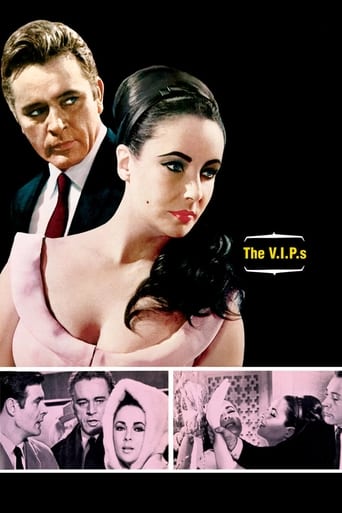
The V.I.P.s (1963)
THIS IS THE STORY OF ONE DRAMATIC, DEVASTATING NIGHT ...in the glamorous private world of the very rich, the very famous, the very beautiful, the very powerful ...the "Very Important Persons"!
Wealthy passengers fogged in at London's Heathrow Airport fight to survive a variety of personal trials.
- Date of release
- 1963-09-01
- TMDB
- 6.2 / 10 (70)
- Runtime
- 1h 59m
- Genres
- Drama
- Director
- Anthony Asquith
Casting
- Elizabeth Taylor — Frances Andros
- Richard Burton — Paul Andros
- Louis Jourdan — Marc Champselle
- Elsa Martinelli — Gloria Gritti
- Margaret Rutherford — The Duchess of Brighton
- Maggie Smith — Miss Mead
- Rod Taylor — Les Mangrum
- Orson Welles — Max Buda
- Linda Christian — Miriam Marshall
- Dennis Price — Cmdr. Millbank
- Richard Wattis — Sanders
- David Frost — Reporter
Interesting facts
- Awards: 1 · Nominations: 1. Including: Academy Award for Best Supporting Actress
The V.I.P.s is a 1963 British comedy-drama film in Metrocolor and Panavision. It was directed by Anthony Asquith, produced by Anatole de Grunwald, and distributed by Metro-Goldwyn-Mayer. The film was written by Terence Rattigan, with a music score by Miklós Rózsa.
Production
According to a biography of Rattigan, the idea of the film originated with the writer's experience of a flight delay due to fog at London Airport; and one of the story lines is drawn from the true story of actress Vivien Leigh's attempt to leave her husband, actor Laurence Olivier, for the actor Peter Finch, but Leigh got trapped in the VIP lounge at Heathrow due to fog.
Asquith intended for Sophia Loren to play Taylor's role, remembering the box-office success of The Millionairess (1960) he did with Loren in the main role. However, Taylor, scared by the appeal Loren had for Burton, persuaded Asquith to hire her instead; "Let Sophia stay in Rome", she told him. Taylor's fee was $1 million (£357,143).
This was the first time Australian actor Rod Taylor had played an Australian character on film. Terence Rattigan allowed him to Australian-ise some of the dialogue. Stringer Davis, Rutherford's husband, appears in a tiny role as a sympathetic hotel waiter in a scene with her. Raymond Austin, a stuntman and a friend of Burton, appears in the film as Andros's driver.
The film was shot entirely at MGM-British Studios, Borehamwood, Herts., with a few establishing shots filmed at what was then known as London Airport, later Heathrow. The terminal set was one of the largest ever constructed in the UK.
Read on Wikipedia · Text from Wikipedia, CC BY-SA 4.0. Data from Wikidata.
Recommended
- Derailed 2005 · ★ 6.4
- Locke 2014 · ★ 6.9
- 7500 2019 · ★ 6.2
- The Dog Stars 2026 · ★ 6.6
- Gone Girl 2014 · ★ 7.9
- Turbulence 2025 · ★ 6.4
- Hotel Mumbai 2019 · ★ 7.5
- The Killing of a Sacred Deer 2017 · ★ 7.0
- Dirty Angels 2024 · ★ 6.1
- A Mighty Heart 2007 · ★ 6.4
- Angel Face 1953 · ★ 7.1
- Panic Room 2002 · ★ 6.8