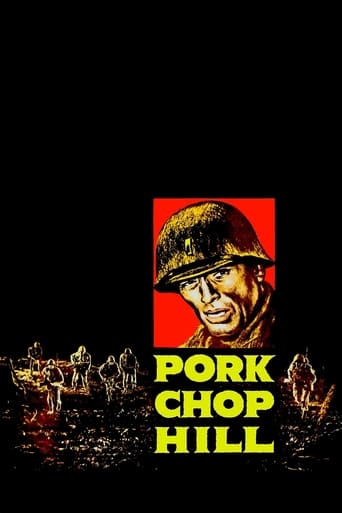
Pork Chop Hill (1959)
Bold! Blunt! Blistering! The battle picture without equal!
Korean War, April 1953. Lieutenant Clemons, leader of the King company of the United States Infantry, is ordered to recapture Pork Chop Hill, occupied by a powerful Chinese Army force, while, just seventy miles away, at nearby the village of Panmunjom, a tense cease-fire conference is celebrated.
- Date of release
- 1959-05-29
- TMDB
- 6.7 / 10 (79)
- Runtime
- 1h 38m
- Genres
- Drama, History, War
- Director
- Lewis Milestone
Casting
- Gregory Peck — Lt. Joe Clemons
- Harry Guardino — PFC. Forstman
- Rip Torn — Lt. Walter Russell
- George Peppard — Cpl. Chuck Fedderson
- Carl Benton Reid — American Admiral
- James Edwards — Cpl. Jurgens
- Bob Steele — Col. Kern
- Woody Strode — Pvt. Franklen
- George Shibata — Lt. Suki Ohashi
- Norman Fell — S/Sgt. Coleman
- Lew Gallo — DPR Lieutenant
- Robert Blake — Pvt. Velie
Interesting facts
- Filmed in: California
Pork Chop Hill is a 1959 American Korean War film starring Gregory Peck, Woody Strode, Rip Torn, and George Peppard. The film, which was the final war film directed by Lewis Milestone, is based upon the 1956 book by U.S. military historian Brigadier General S. L. A. Marshall. It depicts the first fierce Battle of Pork Chop Hill between the U.S. Army's 7th Infantry Division and Chinese and North Korean forces in April 1953.
Production
The film was based on Marshall's book Pork Chop Hill published in 1956. The New York Times called it "unforgettable".
In August 1957 the film rights were bought by Melville Productions, the film company of Gregory Peck. Sy Bartlett was to produce and James Webb was to write the script. It was Webb who recommended the project to Melville. He decided to focus the action on Company K, who took up a chapter in the book, "All the King's Men", over a 24-hour period.
S.L.A. Marshall reportedly disliked the fact that he had sold the movie rights to his book for next-to-nothing, and vowed not to make the same mistake again.
In January 1958 Lewis Milestone agreed to direct. He and Bartlett wanted to cast unknowns in support of Peck and saw over 600 actors for 83 speaking parts.
Strode and Edwards' portrayal of African American soldiers is based on the 24th Infantry Regiment, which was still racially segregated in Korea. All Black units were integrated in the summer and fall of 1951 and all Black units were integrated and closed out on 1 October 1951. Like its cinematic portrayal, the real regiment was poorly trained, poorly equipped and poorly led.
Read on Wikipedia · Text from Wikipedia, CC BY-SA 4.0. Data from Wikidata.
Recommended
- Men in War 1957 · ★ 6.6
- The Great Raid 2005 · ★ 6.6
- For Greater Glory: The True Story of Cristiada 2012 · ★ 7.0
- MacArthur 1977 · ★ 6.2
- King Rat 1965 · ★ 7.1
- Walking with the Enemy 2014 · ★ 6.3
- Force 10 from Navarone 1978 · ★ 6.3
- Letters from Iwo Jima 2006 · ★ 7.5
- Field of Lost Shoes 2015 · ★ 6.1
- Play Dirty 1969 · ★ 6.3
- Ike: Countdown to D-Day 2004 · ★ 6.5
- The Kill Team 2019 · ★ 6.5