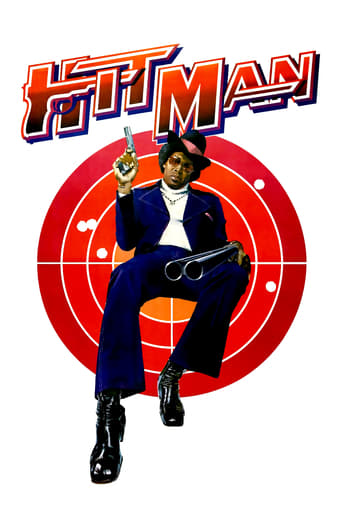
Hitman, le Créole de Harlem (1972)
Hit Man
Un ancien policier découvre que la mort récente de son frère est liée à la fois au milieu criminel de Los Angeles et à l'industrie du cinéma porno de la ville.
- Date de sortie
- 1972-12-20
- TMDB
- 5.6 / 10 (15)
- Durée
- 1 h 30 min
- Genres
- Action, Crime
- Réalisateur
- George Armitage
Distribution
- Bernie Casey — Tyrone Tackett
- Pam Grier — Gozelda
- Lisa Moore — Laural Garfoot
- Bhetty Waldron — Irvelle Way
- Sam Laws — Sherwood Epps
- Don Diamond — Nano Zito
- Bob Harris — Shag Merriweather
- Christopher Joy — Leon
- Marilyn Joi — Nita Biggs
- John Lupton — TV Commercial Director
- Candy All — Rochelle Tackett
- Ed Cambridge — Theatis Oliver
Anecdotes
- Adapté de : Jack's Return Home
Hit Man is a 1972 American crime thriller film written and directed by George Armitage, produced by Gene Corman, and starring Bernie Casey and Pam Grier. It is a blaxploitation-themed adaptation of Ted Lewis' 1970 novel Jack's Return Home, more famously adapted as Get Carter (1971), with the action relocated from England to the United States.
Production
George Armitage says he never saw Get Carter before making the film, claiming that producer Gene Corman gave him a copy of the script with no title and said that MGM owned it. Armitage rewrote it to be set in the African American community, and only then did his agent tell him it was Get Carter. Armitage:
I didn't feel at the time that a white director should be directing it. So I met with Bernie Casey, the film's star, who wanted to direct it, and campaigned for him with Gene, and he said: "I don't want to take a chance on someone who hasn't directed." So he wasn't going to make the picture, and at that point there was a lot of crew and cast involved, and they were friends, so I said: "Okay, I'll do it." There was a great deal of improvisation by…
The film follows details from Lewis' novel more closely than Get Carter, and does not end with the protagonist's death.
Hit Man marked the second time Corman had produced a blaxploitation film for Metro-Goldwyn-Mayer (MGM) that was based on a novel which had previously been adapted for one of the company's films, following Cool Breeze, an adaptation of W. R. Burnett's novel The Asphalt Jungle, which had previously inspired the film of the same name.
Future director Andrew Davis (Under Siege, The Fugitive) was the film's cinematographer, one of several low-budget films he shot for Gene and Roger Corman during the 1970s. Davis said of his experience:
Lire sur Wikipédia · Texte de Wikipédia, CC BY-SA 4.0. Données de Wikidata.
Recommandés
- Foxy Brown 1974 · ★ 6.3
- Black Cesar, le parrain de Harlem 1973 · ★ 5.9
- Coffy, la panthère noire de Harlem 1973 · ★ 6.6
- Police Fédérale - Los Angeles 1985 · ★ 7.1
- Dead Man Down 2013 · ★ 6.2
- Motor City 2026 · ★ 6.2
- Night Run 2015 · ★ 6.4
- Le Casse de l'oncle Tom 1970 · ★ 6.2
- Sale temps pour un flic 1985 · ★ 6.0
- One Mile: Chapter Two 2026 · ★ 6.6
- Shaft, les nuits rouges de Harlem 1971 · ★ 6.4
- Rogue : L'Ultime Affrontement 2007 · ★ 6.4