Night on the Galactic Railroad (1985)
銀河鉄道の夜
Japan's most beloved children's book is now a hauntingly beautiful feature film.
Lonely and awkward, Giovanni struggles with his sick mother, absent father, and an afterschool job that isolates him from his peers. But on the night of the Festival of Stars, he is magically transported onto a celestial train with his only friend, Campanella. Together, they embark on an extraordinary journey through the galaxy, encountering mysterious characters and grappling with life's deepest questions.
- Date of release
- 1985-07-13
- TMDB
- 7.1 / 10 (108)
- Runtime
- 1h 48m
- Genres
- Adventure, Animation, Drama, Family, Fantasy
- Director
- Gisaburō Sugii
Casting
- Mayumi Tanaka — Giovanni (voice)
- Chika Sakamoto — Campanella (voice)
- Junko Hori — Zanelli (voice)
- Kaori Nakahara — Kaoru (voice)
- Yoshie Shimamura — Giovanni's Mother (voice)
- Reiko Niimura — Old Woman (voice)
- Ayumi Ishijo — (voice)
- Ayako Hori — (voice)
- Chikao Ohtsuka — Birdcatcher (voice)
- Hidehiro Kikuchi — Young Man (voice)
- Yuriko Fuchizaki — Tadashi (voice)
- Shun Yashiro — (voice)
Interesting facts
- Based on: Night on the Galactic Railroad
Night on the Galactic Railroad , also known as Giovanni and Campanella in some markets, is a 1985 Japanese anime film directed by Gisaburo Sugii, based on Hiroshi Masumura's manga adaptation of the 1934 fantasy novel of the same name by Kenji Miyazawa. The film's screenplay was written by Minoru Betsuyaku. Its plot follows a young cat named Giovanni, who journeys on a train with his classmate Campanella through the Milky Way galaxy.
Production
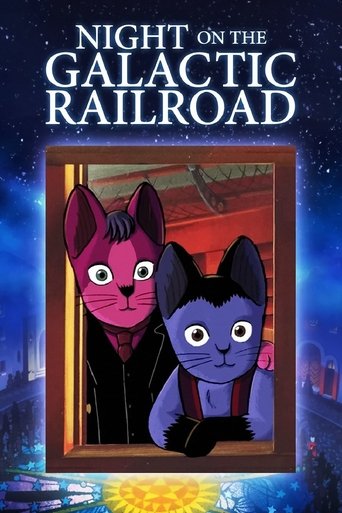
The film was produced independently by Nippon Herald Films and animated by Group TAC. The most prominent alteration made in the film is that the main two characters (and their classmates) are depicted as anthropomorphic cats. Some other characters, such as the children from the ship, are humans.
The captions throughout the film are in Esperanto as an homage to Kenji Miyazawa, who was strongly interested in the language. The film's title in Esperanto is Nokto de la Galaksia Fervojo and is shown on the cover of the soundtrack. Text appearing in various scenes was also written in Esperanto, such as writing on the blackboard in the classroom.
The film soundtrack was composed by Yellow Magic Orchestra member Haruomi Hosono. Storyboard artist Kōichi Mashimo went on to form the animation studio Bee Train.
The second movement of Dvořák's ninth symphony scores a scene toward the end of the film that is titled after the piece's popular name, New World Symphony.
Read on Wikipedia · Text from Wikipedia, CC BY-SA 4.0. Data from Wikidata.
Recommended
- The Cat Returns 2002 · ★ 7.1
- Brave Story 2006 · ★ 6.4
- If Cats Disappeared from the World 2016 · ★ 6.7
- The Imaginary 2023 · ★ 7.6
- Mary and The Witch's Flower 2017 · ★ 7.2
- The Girl from the Other Side 2023 · ★ 7.8
- My Oni Girl 2024 · ★ 7.2
- The Little Prince 2015 · ★ 7.6
- Angel's Egg 1985 · ★ 7.7
- Doraemon: Nobita and the Haunts of Evil 1982 · ★ 6.7
- Welcome to Smelliville 2021 · ★ 6.7
- Epic 2013 · ★ 6.6