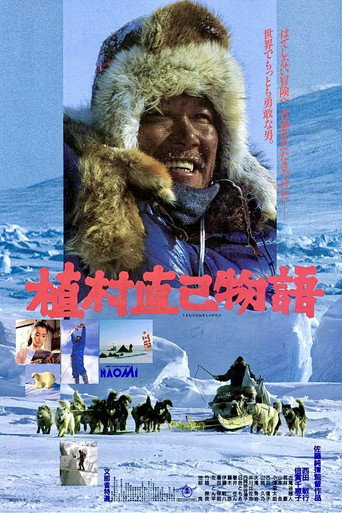
植村直己物語 (1986)
电影采取人文纪录片式的写实风格,忠实再现了植村直己从登顶珠穆朗玛峰到征服北极点的半生足迹。影片重点描绘了他作为第一个登顶世界五大洲最高峰的日本人,以及乘雪橇犬横越阿拉斯加、独自徒步抵达北极点等一系列惊心动魄的壮举。电影没有一味地神话英雄,而是花了不少篇幅展现植村直己作为普通人的一面,甚至包括他把焦虑发泄在妻子身上的争吵。妻子公子,在后方默默承受孤独、坚定且温柔地守候着日夜活在冒险中的丈夫。
演员阵容
- 西田敏行 — Naomi Uemura
- 倍赏千惠子 — Kimiko, Naomi's wife
- 古尾谷雅人 — Masao Ogawa
- 若林豪 — Hiroto Nagatsuka
- 竹胁无我 — Ishiyama
- 山冈久乃 — Hideyo Nazaki
- 乙羽信子 — Yasuko Moto
- 大泷秀治 — Matsutaro Uemura
- 丹阿弥谷津子 — Hatsu Uemura
- 井川比佐志 — Osamu Uemura
- 小林トシ江 — Osamu's wife
- 小泽荣太郎 — Eijiro Nishikawa
趣闻
Lost in the Wilderness is a 1986 Japanese epic biographical adventure drama film directed by Jun'ya Satō. It was co-written by Satō with Yoshiki Iwama. The film is based on the life and writings of Naomi Uemura, a famous Japanese adventurer and mountain climber who went missing on Denali in 1984. It stars Toshiyuki Nishida as Uemura, in addition to Chieko Baisho, Masato Furuoya, Go Wakabayashi and Muga Takewaki. Japanese composer Kunihiko Murai and three members of Windham Hill Records co-composed the film's score. Lost in the Wilderness was theatrically released by Toho on 7 June 1986, in Japan.
Production
Shortly after Uemura went missing and was presumed dead, Dentsu and Mainichi Broadcasting System conceived a joint film project that would celebrate his life and achievements. Author Makoto Shiina was the top choice for the role of Uemura, as Shiina was a physically active travel writer who had met Uemura twice and befriended him (with one of their dialogues being published in a magazine).
Shiina ultimately dropped out due to scheduling conflicts with the TBS Television 30th anniversary special Siberia Grand Journey (inspired by his book Journey at Minus 59 Degrees: Makoto Shiina's Siberian Pursuit of Extreme Cold). Moritani, who was in poor health at the time, also had to drop out of the production (he died on 2 December 1984). After Moritani dropped out, Jun'ya Satō was offered the directing job.
The production was announced on 29 January 1985. It was greenlit with a budget of ¥1.5 billion. The film was Dentsu's first major foray into film production. Isao Matsuoka, Toho's president at the time, stated that he believed Lost in the Wilderness would be "a wonderful film", and that Toho was aiming for "a box office revenue of 5.5 billion yen"; box office expectations were placed on a similar level to Antarctica (1983), which was the highest-…
Production commenced on 1 March 1985. Satō used 35 mm film stock and shot in VistaVision. Filming took over a year to complete. The film was shot on location at Denali, the Arctic Circle, Mont Blanc, Greenland, Mount Kilimanjaro, the Amazon rainforest and Mount Everest. Two cinematographers were hired for the production: Hiroyuki Namiki and Etsuo Akutsu. Namiki was the primary cinematographer, while Akutsu was credited with mountain photography.
Location shooting on Everest took place from August to October 1985. The production's base camp was located at 5,350 meters. Filming and route preparation were split between the 11-person crew and the climbing team, both of which were mainly composed of members of the Gunma Prefecture Mountaineering Federation, which included several top Japanese mountaineers of the time.
在维基百科阅读更多 · 文本来自维基百科,CC BY-SA 4.0。数据来自 Wikidata。
推荐
- 登峰传奇:丹增诺盖 2026 · ★ 8.3
- 绝命海拔 2015 · ★ 6.8
- 登山家 2021 · ★ 7.8
- 失落之城 2017 · ★ 6.4
- 太阳王 1963 · ★ 6.2
- 热气球飞行家 2019 · ★ 6.8
- 西藏七年 1997 · ★ 7.2
- 宫本武藏 完结篇:决斗岩流岛 1956 · ★ 7.2
- 冰峰168小时 2003 · ★ 7.6
- 女座头市 2008 · ★ 6.8
- 手冢治虫的佛陀:美丽的红色沙漠 2011 · ★ 7.4
- 宝可梦剧场版:就决定是你了! 2017 · ★ 7.1