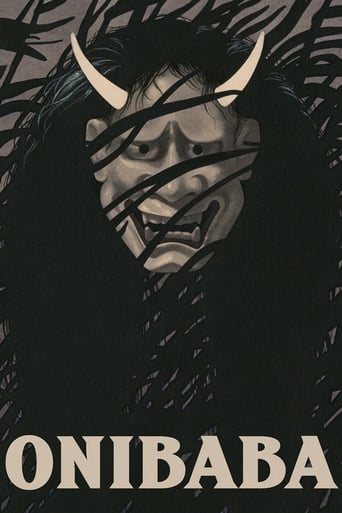
Onibaba (1964)
鬼婆
The most daring film import ever...From Japan!
While her son, Kichi, is away at war, a woman and her daughter-in-law survive by killing samurai who stray into their swamp, then selling whatever valuables they find. Both are devastated when they learn that Kichi has died, but his wife soon begins an affair with a neighbor who survived the war, Hachi. The mother disapproves and, when she can't steal Hachi for herself, tries to scare her daughter-in-law with a mysterious mask from a dead samurai.
- Date of release
- 1964-11-21
- TMDB
- 7.7 / 10 (510)
- Runtime
- 1h 45m
- Genres
- Horror
- Director
- Kaneto Shindō
Casting
- Nobuko Otowa — Woman
- Jitsuko Yoshimura — Young Woman
- Kei Satō — Hachi
- Jūkichi Uno — The Samurai
- Taiji Tonoyama — Ushi
- Someshō Matsumoto — Runaway Warrior
- Kentarô Kaji — Runaway Warrior
- Fudeko Tanaka — Old Woman
- Hiroyoshi Yamaguchi — Horse Riding Samurai
- Hiroshi Tanaka — Horse Riding Samurai
- Kanzō Uni — Horse Riding Samurai
- Hosui Araya — Ushi's Follower
Interesting facts
Onibaba is a 1964 Japanese period horror film written and directed by Kaneto Shindō. Set during a civil war in medieval Japan, it stars Nobuko Otowa and Jitsuko Yoshimura as two women who kill infighting soldiers to steal their armor and possessions for survival, while Kei Satō plays the man who ultimately comes between them.
Production
Onibaba was inspired by the Shin Buddhist parable of yome-odoshi-no men (嫁おどしの面; bride-scaring mask) or niku-zuki-no-men (肉付きの面; mask with flesh attached), in which a mother, disgusted by her daughter's affair with a priest, used a mask to pose as a demon and frighten the girl into believing that she was cursed.
Shindo said that the effects of the mask on those who wear it are symbolic of the disfigurement of the victims of the Atomic bombings of Hiroshima and Nagasaki, the film reflecting the traumatic effect of this visitation on post-war Japanese society.
Most of the cast consisted of members of Shindo's regular group of performers, Nobuko Otowa, Kei Satō, Taiji Tonoyama, and Jūkichi Uno. This was Jitsuko Yoshimura's only appearance in a Shindo film. The two women do not have names even in the script, but are merely described as "middle-aged woman" and "young woman".
Kaneto Shindo wanted to film Onibaba in a field of susuki grass. He sent out assistant directors to find suitable locations. Once a location was found near a river bank at Inba Swamp in Chiba Prefecture, they put up prefabricated buildings to live in. Filming started on June 30, 1964, and continued for three months.
They had a rule that if somebody left they would not get any pay, to keep the crew motivated to continue. Shindo included dramatized scenes of the dissatisfaction on the set as part of the 2000 film By Player.
Read on Wikipedia · Text from Wikipedia, CC BY-SA 4.0. Data from Wikidata.
Recommended
- Tomie: Rebirth 2001 · ★ 7.2
- Ninja Scroll 1993 · ★ 7.8
- Samurai Reincarnation 1981 · ★ 5.8
- Monster Island 2025 · ★ 6.2
- Imprint 2006 · ★ 6.9
- Versus 2000 · ★ 6.2
- Ju-on: The Grudge 2002 · ★ 6.8
- Demon City Shinjuku 1988 · ★ 6.0
- The Grudge 2004 · ★ 5.9
- Howling Village 2020 · ★ 5.8
- Devilman - Volume 3: Devilman Apocalypse 2000 · ★ 7.0
- Wicked City 1987 · ★ 6.7