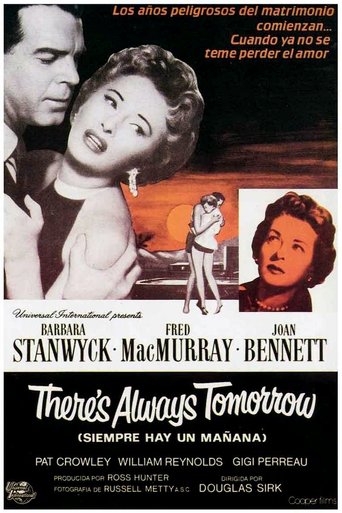
Siempre hay un mañana (1956)
There's Always Tomorrow
Clifford Groves (Fred MacMurray), es un fabricante de juguetes, cansado de la rutina y con la impresión de no ser debidamente apreciado por su mujer (Joan Bennett) y sus hijos. Se reencuentra con una antigua amiga, Norma Miller Vale (Barbara Stanwyck), a la que no ve desde hace veinte años, y a raíz de ello comienza a replantearse su vida. Su hijo (William Reynolds) comienza a sospechar que puede haber algo más entre ellos.
- Fecha de estreno
- 1956-01-08
- TMDB
- 7.2 / 10 (77)
- Duración
- 1 h 24 min
- Géneros
- Drama, Romance
- Director
- Douglas Sirk
Reparto
- Fred MacMurray — Clifford Groves
- Barbara Stanwyck — Norma Miller Vale
- Joan Bennett — Marion Groves
- William Reynolds — Vincent 'Vinnie' Groves
- Pat Crowley — Ann
- Gigi Perreau — Ellen Groves
- Jane Darwell — Mme Rogers
- Race Gentry — Bob
- Myrna Hansen — Ruth
- Judy Nugent — Frances 'Frankie' Groves
- Paul Smith — Bellboy
- Helen Kleeb — Miss Walker
Curiosidades
There's Always Tomorrow is a 1956 American romantic melodrama film directed by Douglas Sirk and starring Barbara Stanwyck, Fred MacMurray and Joan Bennett. The screenplay by Bernard C. Schoenfeld was adapted from the novel of the same name by Ursula Parrott. The plot concerns a man's unhappiness with his domestic life and romantic relationship with a former employee. The film was produced by Ross Hunter for Universal Pictures, which had also produced the 1934 adaptation of Parrott's novel. It was released in the United States on January 8, 1956.
Production notes
This film was Universal's second adaptation of Ursula Parrott's novel. The earlier film, directed by Edward Sloman, provided a rare early leading role for Frank Morgan and featured Binnie Barnes in the Stanwyck role and Lois Wilson in the Bennett role.
MacMurray and Stanwyck had costarred in three previous films: the Remember the Night (1940), Double Indemnity (1944) and The Moonlighter (1953).
Douglas Sirk wanted his version of There's Always Tomorrow to be filmed in color, but Universal refused. However, the studio granted Sirk's request to hire cinematographer Russell Metty.
The scenes in the film set at the fictional Palm Valley Inn were filmed at the Apple Valley Inn in Apple Valley, California.
Leer en Wikipedia · Texto de Wikipedia, CC BY-SA 4.0. Datos de Wikidata.
Recomendadas
- Hola, adiós y todo lo que pasó 2022 · ★ 6.1
- Nueve vidas 2005 · ★ 6.1
- Lovely, Still 2009 · ★ 6.6
- Donde el helecho rojo crece 2003 · ★ 6.6
- Flicka 2006 · ★ 6.9
- Una canción de amor 2022 · ★ 6.6
- Separados por accidente 2009 · ★ 6.3
- Where the Red Fern Grows 1974 · ★ 6.9
- La lectora 2017 · ★ 6.1
- Corazones malheridos 2022 · ★ 8.0
- El secreto: Atrévete a soñar 2020 · ★ 7.4
- Salto a la fama (Turn It Up) 2008 · ★ 6.9