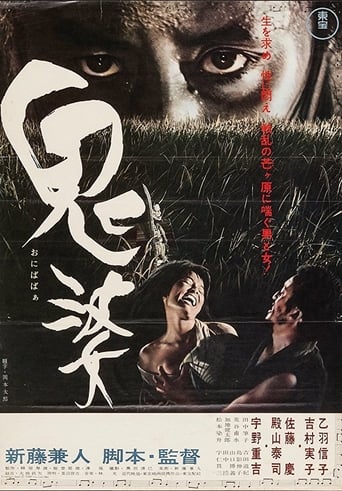
鬼婆 (1964)
日本南北朝时期,战乱不断,人民流离失所。一对婆媳生活在野草丛生的平原中,干着捕杀掉队士兵并剥掉铠甲换取食物的营生。 某晚,年轻的士兵八(佐藤庆 饰)从战场上归来,告诉婆婆(乙羽信子 饰)她的儿子已死,并留下来和婆媳一起生活。八不断挑逗儿媳(吉村实子 饰),终于有天晚上儿媳不顾一切,奔向八的住地,两人绞在一起…… 婆婆生怕儿媳离自己而去。正无计可施时,遇到带着鬼面具、声称拥有娇美面容的武士(宇野重吉 饰)。婆婆害死武士,戴着面具出没荒草之间,希望扮鬼吓退儿媳,但最终失败。然而更恐怖的是,婆婆戴上的正是一个被诅咒了的面具……
演员阵容
- 乙羽信子 — Woman
- 吉村实子 — Young Woman
- 佐藤庆 — Hachi
- 宇野重吉 — The Samurai
- 殿山泰司 — Ushi
- 松本染升 — Runaway Warrior
- 加地健太郎 — Runaway Warrior
- 田中笔子 — Old Woman
- 山口博义 — Horse Riding Samurai
- 田中浩 — Horse Riding Samurai
- 宇仁貫三 — Horse Riding Samurai
- Hosui Araya — Ushi's Follower
趣闻
Onibaba is a 1964 Japanese period horror film written and directed by Kaneto Shindō. Set during a civil war in medieval Japan, it stars Nobuko Otowa and Jitsuko Yoshimura as two women who kill infighting soldiers to steal their armor and possessions for survival, while Kei Satō plays the man who ultimately comes between them.
Production
Onibaba was inspired by the Shin Buddhist parable of yome-odoshi-no men (嫁おどしの面; bride-scaring mask) or niku-zuki-no-men (肉付きの面; "flesh-fused" or "flesh-bound" mask), in which a mother-in-law, resenting her daughter-in-law's nightly visits to a temple to hear Buddhist sermons, puts on a demon mask to frighten her on the road. As punishment, the mask sticks fast, and when it finally comes away, it takes the skin of her face with it.
In a 2003 interview for the Criterion Collection, Shindo said that the mask's effect on its wearer symbolizes the disfigurement of victims of the atomic bombings of Hiroshima and Nagasaki, and that the film reflects the trauma the bombings left on postwar Japanese society.
Most of the cast consisted of members of Shindo's regular group of performers, Nobuko Otowa, Kei Satō, Taiji Tonoyama, and Jūkichi Uno. This was Jitsuko Yoshimura's only appearance in a Shindo film. The two women do not have names even in the script, but are merely described as "middle-aged woman" and "young woman".
In a 2003 interview for the Criterion Collection, Kaneto Shindo said he wanted to film Onibaba in a field of susuki grass, and sent assistant directors to find a location. Once a location was found near a river bank at Lake Inba (Inba-numa) in Chiba Prefecture, they put up prefabricated buildings to live in. Filming started on 30 June 1964, and continued for three months.
They had a rule that if somebody left they would not get any pay, to keep the crew motivated to continue. Shindo included dramatized scenes of the dissatisfaction on the set as part of the 2000 film By Player.
在维基百科阅读更多 · 文本来自维基百科,CC BY-SA 4.0。数据来自 Wikidata。