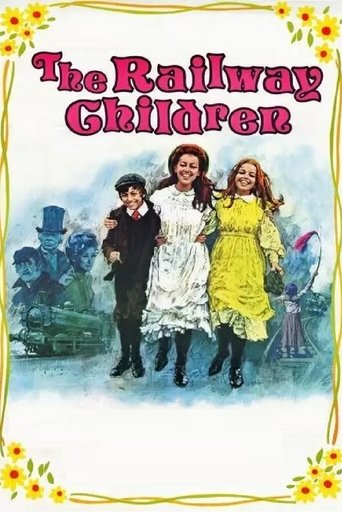
The Railway Children (1970)
The railway, the children... and the wonderful secret they'll share with you!
At the dawn of the 20th century, following their father's arrest on suspicion of betraying state secrets, the three Waterbury children—Bobbie, Phyllis and Peter—move with their mother to Yorkshire, where they find themselves involved in unexpected dramas along the railway by their new home.
- Date of release
- 1970-12-21
- TMDB
- 6.7 / 10 (111)
- Runtime
- 1h 49m
- Genres
- Drama, Family
- Director
- Lionel Jeffries
- Collection
- The Railway Children Collection
Casting
- Dinah Sheridan — Mrs. Waterbury
- Bernard Cribbins — Albert Perks
- William Mervyn — Old Gentleman
- Iain Cuthbertson — Charles Waterbury
- Jenny Agutter — Roberta 'Bobbie' Waterbury
- Sally Thomsett — Phyllis Waterbury
- Gary Warren — Peter Waterbury
- Peter Bromilow — Doctor
- Ann Lancaster — Ruth
- Gordon Whiting — Russian
- Beatrix Mackey — Aunt Emma
- David Lodge — Bandmaster
Interesting facts
- Based on: The Railway Children
The Railway Children is a 1970 British family drama film based on the 1906 novel of the same name by E. Nesbit. The film was directed by Lionel Jeffries and stars Dinah Sheridan, Jenny Agutter, Sally Thomsett, Gary Warren and Bernard Cribbins in the leading roles. The film was released to cinemas in the United Kingdom on 21 December 1970.
Production
It was serialised for television in 1951, as a part of Children's Hour, starring Jean Anderson. The 1951 script was reworked and adapted for television again in 1957, with location scenes filmed on the now-closed Cranleigh line. Jean Anderson reprised her role as Mother.
In 1968, a seven-part television series was made with a fully-revised script. The series starred Jenny Agutter and the fledgling Keighley & Worth Valley Railway, with its station at Oakworth, was used for location scenes.
Lionel Jeffries read the book for the first time when he was returning to Britain by ship from the US to film Chitty Chitty Bang Bang, in which he appeared as an actor. He had lost his own books and borrowed The Railway Children from his 13-year-old daughter Martha. He loved it, although he admitted "my personality is so different from the quiet romance of the story." However, he said "I found the climate of the...
He bought a six-month option on the film rights for £300 and wrote a screenplay. "I've kept to the story," said Jeffries. "It would be an imposition not to – after all, E. Nesbit's survived 50 years." Jeffries succeeded in attracting financing from Bryan Forbes at EMI Films, who was interested in making family films. Forbes suggested Jeffries direct.
Jeffries later said "I knew we were taking a big, calculated risk in swimming against the permissive mainstream with such a story. All I could do was make it as honestly as possible: a Victorian documentary."
Read on Wikipedia · Text from Wikipedia, CC BY-SA 4.0. Data from Wikidata.
Recommended
- The Railway Children Return 2022 · ★ 6.5
- Wild Hearts Can't Be Broken 1991 · ★ 7.3
- The Young and Prodigious T.S. Spivet 2013 · ★ 6.9
- Greyfriars Bobby 1961 · ★ 6.9
- Where the Red Fern Grows 2003 · ★ 6.6
- Spencer's Mountain 1963 · ★ 6.7
- The Greening of Whitney Brown 2011 · ★ 5.9
- Black Beauty 1994 · ★ 6.7
- The Secret Garden 2020 · ★ 6.3
- Oliver Twist 1997 · ★ 6.2
- The Stray 2017 · ★ 6.2
- A Taste of Honey 1961 · ★ 7.1