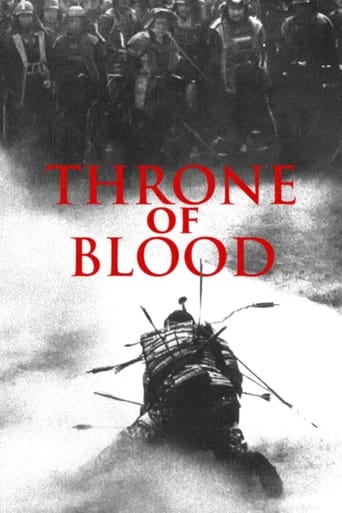
Throne of Blood (1957)
蜘蛛巣城
Returning to their lord's castle, samurai warriors Washizu and Miki are waylaid by a spirit who predicts their futures. When the first part of the spirit's prophecy comes true, Washizu's scheming wife, Asaji, presses him to speed up the rest of the spirit's prophecy by murdering his lord and usurping his place. Director Akira Kurosawa's resetting of William Shakespeare's "Macbeth" in feudal Japan is one of his most acclaimed films.
- Date of release
- 1957-01-15
- TMDB
- 7.9 / 10 (1037)
- Runtime
- 1h 48m
- Genres
- Drama, History
- Director
- Akira Kurosawa
Casting
- Toshirō Mifune — Taketoki Washizu
- Isuzu Yamada — Lady Asaji Washizu
- Takashi Shimura — Noriyasu Odagura
- Akira Kubo — Yoshiteru Miki
- Hiroshi Tachikawa — Kunimaru Tsuzuki
- Minoru Chiaki — Yoshiaki Miki
- Takamaru Sasaki — Kuniharu Tsuzuki
- Gen Shimizu — Washizu samurai
- Kokuten Kōdō — Military Commander
- Kichijirō Ueda — Washizu's workman
- Eiko Miyoshi — Old Woman at castle
- Chieko Naniwa — Old Ghost Woman
Interesting facts
- Based on: Macbeth
- Filmed in: Japan
- Awards: 2 · Nominations: 0. Including: Blue Ribbon Awards
Throne of Blood is a 1957 Japanese epic jidaigeki film directed, co-written, produced, and edited by Akira Kurosawa, with special effects by Eiji Tsuburaya. The film transposes the plot of English dramatist William Shakespeare's play Macbeth (1606) from Medieval Scotland to feudal Japan, with stylistic elements drawn from Noh drama. The film stars Toshiro Mifune and Isuzu Yamada in the lead roles, modelled on the characters Macbeth and Lady Macbeth.
Production
William Shakespeare's plays had been read in Japan since the Meiji Restoration in 1868, though banned during World War II for not being Japanese. Director Akira Kurosawa stated that he had admired Shakespeare's Macbeth for a long time, and that he envisioned making a film adaptation of it after he completed his 1950 film Rashomon.
Kurosawa believed that Scotland and Japan in the Middle Ages shared social problems and that these had lessons for the present day. Moreover, Macbeth could serve as a cautionary tale complementing his 1952 film Ikiru.
In May 1956, Kurosawa announced that he would be producing three samurai films for Toho, Throne of Blood, The Hidden Fortress, and Revenge, each to be filmed from September 1956 to early 1957 by other directors. Ishirō Honda, best known for directing the 1954 kaiju film Godzilla, was slated to direct Throne of Blood, but Kurosawa ended up directing all three films himself.
The film combines Shakespeare's play with the Noh style of drama. Kurosawa was an admirer of Noh, which he preferred over Kabuki. In particular, he wished to incorporate Noh-style body movements and set design. Noh also makes use of masks, and the evil spirit is seen, in different parts of the film, wearing faces reminiscent of these masks, starting with yaseonna (old lady). Noh often stresses the Buddhist doctrine of impermanence.
All three of Kurosawa's frequent script collaborators participated for the first time: Hideo Oguni, Shinobu Hashimoto, and Ryūzō Kikushima, each working with the director for their fourth time. Initially, the screenwriters wrote the script with the intention that it would be directed by Ishirō Honda, but Toho insisted Kurosawa take the directing position after reading the script and realizing a large budget was required for the film.
Read on Wikipedia · Text from Wikipedia, CC BY-SA 4.0. Data from Wikidata.
Recommended
- After the Rain 2000 · ★ 7.3
- 47 Ronin 2013 · ★ 6.2
- Kagemusha 1980 · ★ 7.8
- Yojimbo 1961 · ★ 8.1
- Bushido 2024 · ★ 7.4
- Repast 1951 · ★ 7.6
- The Tale of The Princess Kaguya 2013 · ★ 8.1
- Seven Samurai 1954 · ★ 8.5
- A Man 2022 · ★ 7.1
- Late Spring 1949 · ★ 8.0
- The Girl from the Other Side 2023 · ★ 7.8
- Okko's Inn 2018 · ★ 7.2