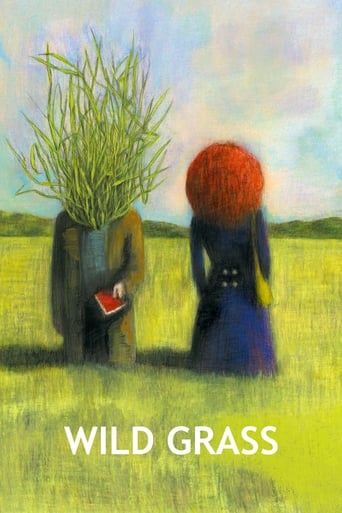
Wild Grass (2009)
Les Herbes folles
A quirky woman who spends her free time as a pilot has her purse stolen; a mysterious man finds her wallet, and they embark on a peculiar romance.
- Date of release
- 2009-11-04
- TMDB
- 5.9 / 10 (92)
- Runtime
- 1h 44m
- Genres
- Drama, Romance
- Director
- Alain Resnais
Casting
- André Dussollier — Georges Palet
- Sabine Azéma — Marguerite Muir
- Emmanuelle Devos — Josepha
- Mathieu Amalric — Bernard de Bordeaux
- Anne Consigny — Suzanne Palet
- Michel Vuillermoz — Lucien d'Orange
- Annie Cordy — la dame de l'immeuble de Marguerite
- Nicolas Duvauchelle — Jean-Mi
- Roger Pierre — Marcel Schwer
- Paul Crauchet — le 1er patient
- Jean-Michel Ribes — le 2ème patient
- Sara Forestier — Elodie
Interesting facts
Wild Grass is a 2009 French comedy-drama film directed by Alain Resnais. The film competed in the main competition at the 2009 Cannes Film Festival.
Production
In preparing the script, Resnais used the dialogue from Gailly's novel, since this had been the element which had particularly attracted him initially, and he repeatedly made reference back to Gailly's style of writing when seeking a rhythm for the film narrative or a visual equivalence for the hesitations and contradictions within his sentences.
In the two principal roles, Resnais used actors with whom he had worked many times before: Sabine Azéma, making her ninth appearance in a Resnais film, and André Dussollier, making his seventh appearance. For the main supporting roles Resnais chose three actors (Anne Consigny, Emmanuelle Devos and Mathieu Amalric) who were new to his films, but who had all worked together in films directed by Arnaud Desplechin (alongside cameraman Éric Gautier).
The story is presented with the help of a voiceover narrator (Édouard Baer) who is almost another character in the film since he seems to be inventing what we see on the spot, complete with hesitations and omissions and changes of tone. It is left to the audience to decide whether his observations about the characters that the audience watches are to be believed or not.
Resnais explained his alteration of the title to Les Herbes folles as a recognition that L'Incident would not work as successfully as a title in a cinematic context as it did for the novel. His "wild grass" refers to a plant that grows in a place where it has no hope of developing: in a crack in a wall, or a ceiling. In the film his principal characters are "two people who have no reason to meet, no reason to love each other".
The film incorporates a number of references to cinema, notably in excerpts from and discussion of the American war film The Bridges at Toko-Ri (1954). The fanfare which traditionally accompanied the 20th Century Fox logo is featured at two points, marking off a section of the film within the film.
Read on Wikipedia · Text from Wikipedia, CC BY-SA 4.0. Data from Wikidata.
Recommended
- The Children of the Century 1999 · ★ 5.9
- When Nietzsche Wept 2007 · ★ 6.1
- Nobody Has to Know 2022 · ★ 6.7
- Beyond the Clouds 1995 · ★ 6.2
- My Brilliant Career 1979 · ★ 6.2
- Haute Couture 2021 · ★ 6.1
- The History of Love 2016 · ★ 6.5
- Racing with the Moon 1984 · ★ 6.3
- Chaos 2001 · ★ 6.4
- Stormy Waters 1941 · ★ 6.7
- Boy Meets Girl 1984 · ★ 6.7
- Love Affair(s) 2020 · ★ 6.3