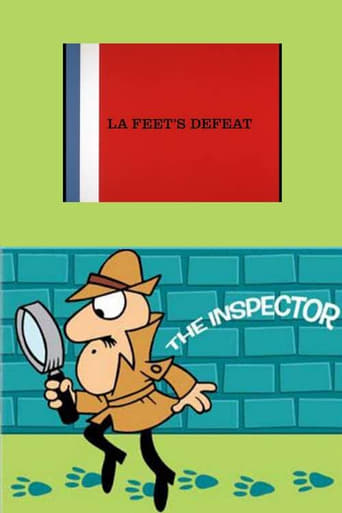
La Feet's Defeat (1968)
The Surete Commissioner assigns Inspector Clouseau and Sergeant Deux-Deux to the hazardous task of pursuing a criminal named Muddy La Feet, who leaves behind a trail of muddy footprints that lead Clouseau and Deux-Deux through a mine field and to a castle surrounded by an alligator-filled moat and sealed by an electrified door. NOTE: Sgt. Deux-Deux's last appearance, this time voiced by Don Messick.
- Date of release
- 1968-07-24
- TMDB
- 7.3 / 10 (3)
- Runtime
- 6m
- Genres
- Animation
- Director
- Gerry Chiniquy
Casting
- Pat Harrington Jr. — Inspector (voice)
- Marvin Miller — Commissioner (voice)
- Don Messick — Sergeant Deux-Deux (voice)
Interesting facts
The Inspector is an American series of 34 theatrical cartoon shorts produced between 1965 and 1969 by DePatie–Freleng Enterprises and released through United Artists. The cartoons are dedicated to an animated version of Inspector Clouseau comically battling against a rogues' gallery of internationally styled villains.
Production
Pat Harrington Jr. provided voices for both the Inspector and Deux-Deux; (in "La Feet's Defeat", Deux-Deux is voiced by Don Messick and sports a younger, more naive appearance.) The Commissioner was voiced by Larry Storch for his first two appearances, before Paul Frees took on the role up until "Bomb Voyage", and voiced the character one last time in "Le Escape Goat".
The first entry in the series, The Great De Gaulle Stone Operation, preceded screenings of the 1965 James Bond film Thunderball.
The Inspector character design remained basically the same throughout the DePatie–Freleng shorts, and was used in the opening credit sequence of the 1968 live-action film Inspector Clouseau (with Alan Arkin as Clouseau), but in the opening titles of later Pink Panther features beginning in the 1970s, his look is changed dramatically to resemble Sellers, and then Steve Martin in the 2006 reboot of the series.
The theme music heard during the titles of the cartoon was the instrumental "A Shot in the Dark" by Henry Mancini, from the 1964 feature film of the same name (the second entry in the Pink Panther live-action film series). Additional music in the cartoons was composed initially by William Lava, then Walter Greene.
17 entries made their television debut during the inaugural season (1969–1970) of The Pink Panther Show, featuring shorter opening titles (minus credits). The remaining 17 entries appeared during the show's second season with complete theatrical opening titles.
Read on Wikipedia · Text from Wikipedia, CC BY-SA 4.0. Data from Wikidata.
Recommended
- Koati 2021 · ★ 7.1
- Kahlil Gibran's The Prophet 2014 · ★ 7.4
- Cranston Academy: Monster Zone 2020 · ★ 6.0
- Inception: The Cobol Job 2010 · ★ 7.2
- Tales of the Black Freighter 2009 · ★ 6.6
- Arctic Dogs 2019 · ★ 5.9
- Strings 2004 · ★ 6.6
- Thru the Mirror 1936 · ★ 7.2
- Scooby-Doo! and the Goblin King 2008 · ★ 7.6
- Puss in Boots: The Three Diablos 2012 · ★ 6.5
- Kung Fu Panda: Secrets of the Masters 2011 · ★ 6.5
- When the Cat's Away 1929 · ★ 5.9