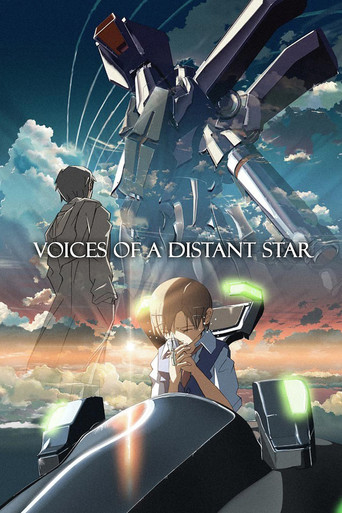
Voices of a Distant Star (2002)
ほしのこえ
A love story that transcends time and space...
It is 2046 when a mysterious alien force begins their annihilation of the human race. Leaving behind the one person she loves, Mikako joins the interstellar battle as a pilot. And so - while Mikako risks her life to save mankind - Noboru waits. The two lovers, worlds apart, desperately strive to remain connected as the gap between them widens at a frightening pace.
- Date of release
- 2002-02-02
- TMDB
- 6.5 / 10 (353)
- Runtime
- 25m
- Genres
- Animation, Science Fiction, Romance
- Director
- Makoto Shinkai
Casting
- Makoto Shinkai — Noboru Terao (voice)
- Mika Shinohara — Mikako Nagamine (voice)
- Donna Burke — Operator of the Lysithea (voice)
- Chihiro Suzuki
- Sumi Mutoh
Interesting facts
Voices of a Distant Star is a Japanese science fiction original video animation (OVA) short film created and animated by Makoto Shinkai. It follows the lives of two close childhood friends, a boy and a girl, who are separated when the girl is sent into space to fight in a war against aliens. As the 15-year-old girl goes deeper and deeper into space, the texts she sends take longer to reach the Earth; the film simultaneously follows her battles and the boy's life as he receives her texts over the years.
Production
Voices of a Distant Star was written, directed and produced by Makoto Shinkai on his Power Mac G4 using LightWave, Adobe Photoshop 5.0, Adobe After Effects 4.1 and Commotion 3.1 DV software. Around June 2000, Shinkai drew the first picture for Voices—of a girl holding a mobile telephone in a cockpit.
Shinkai said the OVA was inspired by Dracula and Laputa. He stated that production took seven months to complete. He said another inspiration was his frequent sending of text messaging to his wife when he was working. Shinkai cited the availability of digital hardware and software tools for image production at his workplace, Falcom, and friends' view that individual film production could occur because of the improvement of consumer electronics.
Makoto and his then girlfriend, Mika Shinohara, provided the voice acting for the working dub. A second Japanese dub was later created for the DVD release with professional voice actors. Makoto's friend Tenmon, who had worked with Makoto's video game company, provided the soundtrack. The song and film were created together in sync during storyboarding. Sometimes, the timing of the animation had to be changed to match the music.
I think it's because of the theme of the story—communication between people. I used cell phones in the story because that is what is commonly used in Japan to communicate, but there are many countries where people don't use cell phones. Communication from the heart is ever-lastingly important wherever you are, so I assume that is why it appealed to so many people. The other thing that is appealing is that I created this animation by myself.
The ending theme to the OVA, "Through the Years and Far Away (Hello, Little Star)", was composed by Tenmon, with lyrics written by K. Juno and sung by Low.
Read on Wikipedia · Text from Wikipedia, CC BY-SA 4.0. Data from Wikidata.
Recommended
- Expelled from Paradise 2014 · ★ 6.5
- Appleseed Alpha 2014 · ★ 6.8
- Bubble 2022 · ★ 7.3
- Dragon Ball Z: The History of Trunks 1993 · ★ 7.7
- NiNoKuni 2019 · ★ 6.5
- Macross: Do You Remember Love? 1984 · ★ 7.2
- Date A Bullet: Nightmare or Queen 2020 · ★ 7.7
- Dragon Ball GT: A Hero's Legacy 1997 · ★ 7.0
- Cosmic Princess Kaguya! 2026 · ★ 8.1
- Her Blue Sky 2019 · ★ 7.4
- Beyond 2003 · ★ 7.3
- Pokémon: Jirachi Wish Maker 2003 · ★ 6.6