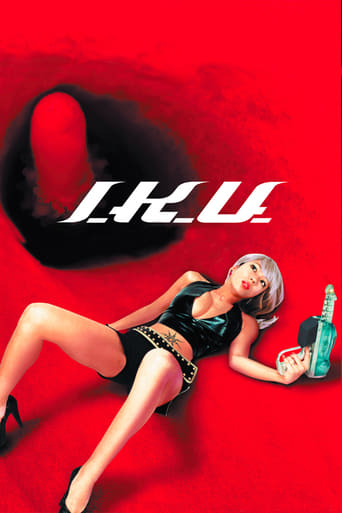
I.K.U. (2001)
This is not love. This is sex.
Reiko is a sex robot programmed to accumulate sexual experience. She goes through seven body types to experiences a variety of couplings. She returns to the company to download her accumulated info and escape from their control.
- Date of release
- 2001-04-29
- TMDB
- 4.8 / 10 (19)
- Runtime
- 1h 5m
- Genres
- Science Fiction, Romance
- Director
- Shu Lea Cheang
Casting
- Aja — Tokyo Rose
- Akira the Hustler — Akira
- Miho Ariga — Reiko #4
- Myū Asō — Reiko #5
- Akechi Denki — Akechi
- Emi — London
- Yumeka Sasaki — Reiko #3
- Ayumu Tokitô — Reiko #1
- Tsousie — Reiko #7
- Etsuyo Tsuchida — Reiko #6
- Maria Yumeno — Reiko #2
- Mash — Mash
Interesting facts
I.K.U. is a 2001 independent film directed by Taiwanese-American experimental filmmaker Shu Lea Cheang. It was marketed as "a Japanese Sci-Fi Porn Feature". The film was partially inspired by Blade Runner (1982). I.K.U.'s premise involves a futuristic corporation sending shapeshifting cyborgs out into New Tokyo to collect "orgasm data" by means of sexual intercourse. The title is a pun on the Japanese word iku which, in sexual slang, is used to express an orgasm.
Production
Producer Takashi Asai, founder of the underground and independent film production company Uplink, commissioned director and media artist Shu Lea Cheang to "make a sci-fi porn film". Cheang began writing the script with the intention of addressing Japanese censorship. Conflicts between the two began during the initial script writing process and lasted throughout production.
Pornographic actress Mai Hoshino was hired for the lead role, Reiko, but disappeared three days before shooting began. Of the subsequent actresses auditioned, Cheang was unable to find one who was both able to act and willing to perform all of the sexual acts outlined in the script.
The film was shot mainly in studio with some location shooting throughout Tokyo over a three-week period. Location shooting included scenes on the metropolitan highways where Andrei Tarkovsky shot the famous driving scene in Solaris (1972). During shooting Cheang came into further conflict with crew members and the police.
Post-production took more than six months although the visual effects company, VJ E-MALE, spent eight months on the film. I.K.U. was completed in July 2000.
Read on Wikipedia · Text from Wikipedia, CC BY-SA 4.0. Data from Wikidata.
Recommended
- RoboCop 2 1990 · ★ 6.0
- Repo Men 2010 · ★ 6.3
- Strawberry Mansion 2021 · ★ 6.8
- Made in Abyss: Wandering Twilight 2019 · ★ 8.2
- Death Race 2 2010 · ★ 5.9
- Heavy Metal 1981 · ★ 6.5
- Space Adventure Cobra 1982 · ★ 6.7
- Hardcore Henry 2015 · ★ 6.4
- Hollow Man 2000 · ★ 6.0
- The Garden of Sinners: A Study in Murder - Part 2 2009 · ★ 7.2
- Watchmen 2009 · ★ 7.4
- A Clockwork Orange 1971 · ★ 8.2