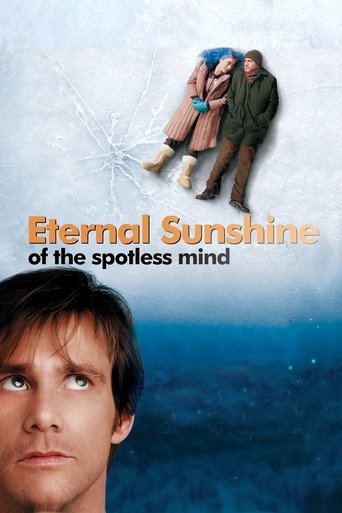
Eternal Sunshine of the Spotless Mind (2004)
You can erase someone from your mind. Getting them out of your heart is another story.
Joel Barish, heartbroken that his girlfriend underwent a procedure to erase him from her memory, decides to do the same. However, as he watches his memories of her fade away, he realises that he still loves her, and may be too late to correct his mistake.
- Date of release
- 2004-03-19
- TMDB
- 8.1 / 10 (17041)
- Runtime
- 1h 48m
- Genres
- Science Fiction, Drama, Romance
- Director
- Michel Gondry
Casting
- Jim Carrey — Joel Barish
- Kate Winslet — Clementine Kruczynski
- Kirsten Dunst — Mary
- Mark Ruffalo — Stan
- Elijah Wood — Patrick
- Tom Wilkinson — Dr. Mierzwiak
- Jane Adams — Carrie
- David Cross — Rob
- Deirdre O'Connell — Hollis
- Thomas Jay Ryan — Frank
- Ryan Whitney — Young Joel
- Lola Daehler — Young Clementine
Interesting facts
- Box office: $74M
- Budget: $20M
- Earned 3.7× its budget
- Filmed in: Long Island, New York City, and New Jersey
- Awards: 2 · Nominations: 3. Including: Academy Award for Best Writing, Original Screenplay; Saturn Award for Best Science Fiction Film
Eternal Sunshine of the Spotless Mind is a 2004 American science fiction romantic drama film directed by Michel Gondry and written by Charlie Kaufman from a story by Gondry, Kaufman, and Pierre Bismuth. It stars Jim Carrey and Kate Winslet as a couple who undergo memory erasure after they break up. Kirsten Dunst, Mark Ruffalo, Elijah Wood and Tom Wilkinson appear in supporting roles. The title of the film is a quotation from the 1717 poem Eloisa to Abelard by Alexander Pope. It uses elements of psychological drama and science fiction and a nonlinear narrative to explore the nature of memory and love.
Production
The concept of Eternal Sunshine of the Spotless Mind came from conversations between director Michel Gondry and co-writer Pierre Bismuth in 1998. The pair had met and become friends in the early 1980s during Gondry's drumming career in the French pop group Oui Oui.
Gondry approached writer Charlie Kaufman with this concept, and they developed it into a short pitch. While the writers did not believe the concept was marketable, a small bidding war began over the idea. Steve Golin of Propaganda Films purchased it on June 12, 1998, for a low seven-figure sum.
During this time, filmmaker Christopher Nolan released Memento (2000), which similarly deals with memory. Due to the similarities, Kaufman became worried and tried to pull out of the project, but Golin made him complete it. During writing, the pitch's ownership changed several times resulting in Kaufman not having to deal with the studios until the end of the scriptwriting process. The final script made the studios nervous.
Kaufman did not want to make the film a thriller and wanted to downplay the science fiction aspects of memory erasure, focusing on the relationship. He had an "enormous struggle" while writing the script, particularly encountering two problems: showing "the memories, Joel's reactions to the memories, and Joel interacting with Clementine outside of the memories in the memories," and the fact that characters could refer in later scenes to already e…
Kaufman resolved the first problem by making Joel lucid and able to comment on his memories and solved the second by making the memories degrade instead of immediately erasing, with complete erasure occurring at awakening. Kaufman's original name for the screenplay was 18 words long, as he had wanted a title that "you couldn't possibly fit on a marquee." He eventually decided on Eternal Sunshine of the Spotless Mind, a title originating from the…
Read on Wikipedia · Text from Wikipedia, CC BY-SA 4.0. Data from Wikidata.
Recommended
- Vanilla Sky 2001 · ★ 6.8
- Unfaithful 2002 · ★ 6.7
- The Greatest Hits 2024 · ★ 6.5
- A Woman of Paris: A Drama of Fate 1923 · ★ 6.7
- Prozac Nation 2003 · ★ 6.4
- Her 2013 · ★ 7.8
- Mr. Nobody 2009 · ★ 7.8
- It Ends with Us 2024 · ★ 6.9
- Trust 2021 · ★ 6.4
- Swan Song 2021 · ★ 7.1
- Two Lovers 2008 · ★ 6.9
- Heights 2005 · ★ 6.3