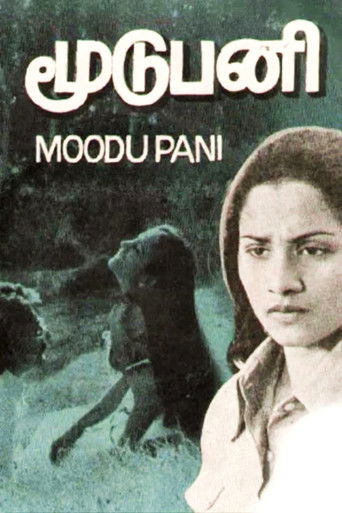
Moodupani (1980)
மூடுபனி
Chandru has a strong hatred towards prostitutes and would kill any such woman he encounters. He falls in love with Rekha and believes marrying her will end his psychological distress.
- Date of release
- 1980-11-06
- TMDB
- 4.2 / 10 (5)
- Runtime
- 2h 11m
- Genres
- Thriller, Horror
- Director
- Balu Mahendra
Casting
- Shoba — Rekha
- Prathap Pothan — Chandru
- N. Viswanathan — Raghunath
- Samikannu
- Gandhimathi — Madam of the brothel
- Mohan — Bhaskar
- Devika Rani
- K. S. Jayalakshmi
- Vijaya Chandrika
- Bhanuchander — Ravi
- G.V. Shivanand
- T S Raju
Interesting facts
- Filmed in: Ooty
Moodu Pani is a 1980 Indian Tamil-language psychological thriller film written, directed and filmed by Balu Mahendra. Starring his then wife Shoba and Pratap, with N. Viswanathan, Gandhimathi, Mohan and Bhanu Chander in supporting roles, it is based on two novels: Idhuvum Oru Viduthalai Thaan (1978) by Rajendra Kumar, and The Collector (1963) by John Fowles. The film follows Chandru (Pratap), who has a strong hatred towards prostitutes and would kill any such woman he encounters. He falls in love with Rekha (Shoba) and believes marrying her will end his psychological distress.
Production
After directing and writing two original films: the Kannada film Kokila (1977) and the Tamil film Azhiyatha Kolangal (1979), Balu Mahendra decided that his third directorial venture be based on a published novel. The film, which would later be titled Moodu Pani, was an adaptation of Idhuvum Oru Viduthalai Thaan, a 1978 Tamil novel by Rajendra Kumar, and The Collector, a 1963 English novel by John Fowles.
Pratap, who previously collaborated with Mahendra on Azhiyatha Kolangal, was cast as Chandru, the mild-mannered and psychopathic serial killer of prostitutes. Mahendra's wife Shoba, who had appeared in both Kokila and Azhiyatha Kolangal, was chosen to play the female lead, with Mahendra claiming the film was "specially made" for her. She was credited in the opening titles as "Shoba Mahendra".
Principal photography for Moodu Pani began in January 1980 and ended in late April, a few days before Shoba's suicide on 1 May, making this the last film she acted in; the last song to be filmed was "Yen Iniya Pon Nilavae". The film was shot primarily in Udupi, Bangalore and Ooty. Mahendra shot the film in hilly places "to capture that misty feel".
Read on Wikipedia · Text from Wikipedia, CC BY-SA 4.0. Data from Wikidata.
Recommended
- The Shed 2019 · ★ 6.1
- Race with the Devil 1975 · ★ 6.4
- Maniac 1963 · ★ 6.2
- Z 2019 · ★ 6.5
- Maanagaram 2017 · ★ 7.4
- Black Widow 1987 · ★ 6.2
- No Name on the Bullet 1959 · ★ 6.6
- The Lady Vanishes 2013 · ★ 6.3
- Por Thozhil 2023 · ★ 7.3
- Angels Fallen: Warriors of Peace 2024 · ★ 5.8
- The MacKintosh Man 1973 · ★ 6.1
- Unseen 2023 · ★ 6.6