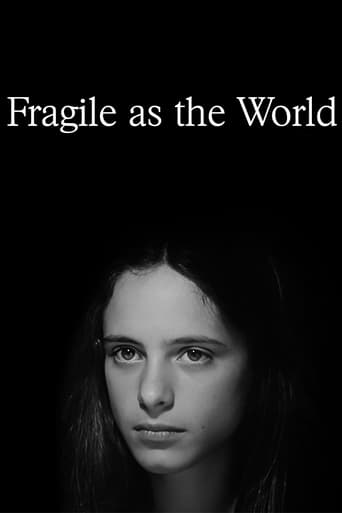
Fragile as the World (2001)
Frágil como o Mundo
An impossible love. Two young people who love each other. Vera and João can’t find in this life the space, time, or identity to resolve their love story.
- Date of release
- 2001-07-20
- TMDB
- 7.6 / 10 (16)
- Runtime
- 1h 31m
- Genres
- Drama, Romance
- Director
- Rita Azevedo Gomes
Casting
- Maria Gonçalves — Vera
- Bruno Terra — João
- Sophie Balabanian — Vera's Mother
- Carlos Ferreira — Vera's Father
- Manuela de Freitas — Grandmother
- João Bénard da Costa — Grandfather
- Carolina Villaverde — Luzinha
- Maria Celestino da Costa — Vera as a Young Girl
- Nuno Nunes — Vera's Brother
- Marta Costa — Vera's Friend
- Margarida Lacerda — Friend
- Henrique Branco — Friend
Interesting facts
Fragile As The World is a 2001 Portuguese arthouse romantic drama film directed and written by Rita Azevedo Gomes and produced by Paulo Branco. Starred by Maria Gonçalves and Bruno Terra. The story follows two young people in love, Vera and João who run away from home and isolate themselves in a forest, promising never to be separated. The film premiered in Portugal on 20 July 2001.
Production
Gomez became interested in the concept of the film after reading an article in 1993 about the suicide of a couple. In her words:
A boy and a girl, found dead very composed, lying without signs of violence, in the shade of a holm oak tree, in a field in Alentejo. It was one of those stories that nobody understood, two children who kill themselves. How did they die? Because, apparently, everything was fine in their lives and nothing suggested that they would do it.
When developing the story into a screenplay, Azevedo Gomes integrated fragments of literary texts by poets like Agustina Bessa-Luís, Cecília Meireles, Luís Vaz de Camões, Rainer Maria Rilke, and Sophia de Mello Breyner Andresen, whose verse "Terror de te amar num sítio tão frágil como o mundo", from the poem Terror de Te Amar, gives the film its title.
With small production means, Gomes started the preparation of "Fragile Like the World" on her own. When Paulo Branco joined the project, most of the pre-production (such as casting, retakes, and props) had already been done by the director.
The filming took place in the Lisbon Metropolitan Area, for example, in places like Sintra and Vila Franca de Xira. Throughout the shooting process, there were several constraints, namely between the director and members of the production. The sound direction was dependent on the availability of the technicians. This forced several scenes to be recorded without direct sound or even use sound.
Read on Wikipedia · Text from Wikipedia, CC BY-SA 4.0. Data from Wikidata.
Recommended
- Fire with Fire 1986 · ★ 6.2
- Foreign Land 1996 · ★ 7.3
- Maria's Lovers 1984 · ★ 6.0
- Time Is Up 2021 · ★ 6.5
- Two for the Seesaw 1962 · ★ 6.5
- Good Luck 2014 · ★ 7.3
- Wander Darkly 2020 · ★ 6.0
- Iron Jawed Angels 2004 · ★ 6.8
- Ashes in the Snow 2018 · ★ 6.3
- Blind 2017 · ★ 6.1
- Hounddog 2008 · ★ 6.5
- Dirt Music 2020 · ★ 6.3