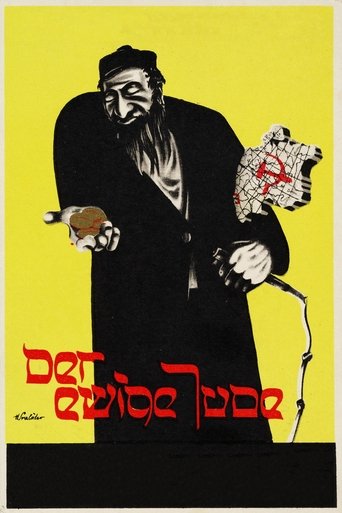
Der ewige Jude (1940)
A Nazi propaganda film made to promote anti-Semitism among the German people. Newly-shot footage of Jewish neighborhoods in recently-conquered Poland is combined with preexisting film clips and stills to defame the religion and advance Hitler's slurs that its adherents were plotting to undermine European civilization.
- Data de estreia
- 1940-11-28
- TMDB
- 4.7 / 10 (55)
- Duração
- 1 h 2 min
- Géneros
- Documentário
- Realizador
- Fritz Hippler
Elenco
- Mona Maris — Self (archive footage)
- Curt Bois — Self (archive footage)
- Fritz Kortner — Dimitri Karamasoff (archive footage)
- Peter Lorre — Hans Beckert (archive footage)
- Ernst Lubitsch — Self (archive footage)
- Rosa Luxemburg — Self (archive footage)
- Charlie Chaplin — Self (1931) (archive footage)
- Kurt Gerron — (archive footage)
- Emil Ludwig — Self (archive footage)
- Richard Oswald — Self (archive footage)
- Max Reinhardt — Self (archive footage)
- Richard Tauber — Self (archive footage)
Curiosidades
The Eternal Jew is a 1940 German antisemitic Nazi propaganda film, presented as a documentary. The initial German title was Der ewige Jude, the German term for the character of the "Wandering Jew" in medieval folklore. Directed by Fritz Hippler at the insistence of the Minister of Propaganda, Joseph Goebbels, the screenplay is credited to Eberhard Taubert and narrated by Harry Giese; it consists of feature and documentary footage combined with materials filmed shortly after the Nazi occupation of Poland. At this time, Poland's Jewish population was about three million, roughly ten percent of the total population.
Production
Although Goebbels did not generally take an active role in particular films' production, he elected to do so in the case of major propaganda such as The Eternal Jew. The film was in production for over a year. Throughout the end of 1939 and the beginning of 1940, Goebbels devoted "constant attention" to the production of what he referred to as "the Jew film".
As early as 1938, Goebbels had wanted to have a film crew travel to Poland to shoot the ghetto scenes; however, he was unable to gain permission from the Polish government. In October and November 1939, almost immediately after the German-Soviet invasion of Poland, he instructed Hippler to send camera crews to Łódź, Warsaw, Kraków and Lublin to shoot footage of Polish Jews.
A rough cut was completed by 18 November 1939. Otto von Kursell suggested ending the film with Hitler's speech from 30 January. Goebbels made additional edits shortly before the German invasion of western Europe.
The footage that Hippler shot in the Jewish ghettos of those cities in German-occupied Poland was the only footage shot specifically for the purpose of the film. At the beginning, animated text informs the audience that this "documentary footage" shows Jews in their original state "before they put on the mask of civilized Europeans." In the Nazi press, Hippler expanded on this claim, asserting that his filming techniques captured Jews "in an unpr…
Although Hippler advertised the film as being a factual documentary consisting of pictures of real Jews with nothing faked or simulated, his claims were complete falsehoods. In reality, the film was an exercise in manipulation for the purposes of propaganda. In shooting his footage, Hippler did in fact simulate scenes and use actors who were performing under duress and without knowledge of how the footage would be employed.
Ler na Wikipédia · Texto da Wikipédia, CC BY-SA 4.0. Dados do Wikidata.
Recomendados
- Hitler, Uma Carreira 1977 · ★ 7.4
- Riefenstahl 2024 · ★ 7.1
- O Triunfo da Vontade 1935 · ★ 6.9
- Nazi Concentration Camps 1945 · ★ 7.7
- The Battle of San Pietro 1945 · ★ 6.1
- Fuck 2006 · ★ 6.4
- A Noite Cairá 2014 · ★ 7.6
- Eldorado: Tudo o Que os Nazis Odeiam 2023 · ★ 7.1
- Paragraph 175 2000 · ★ 6.7
- Hôtel Terminus: The Life and Times of Klaus Barbie 1988 · ★ 7.1
- The War Room 1993 · ★ 6.8
- The Memphis Belle 1944 · ★ 6.7