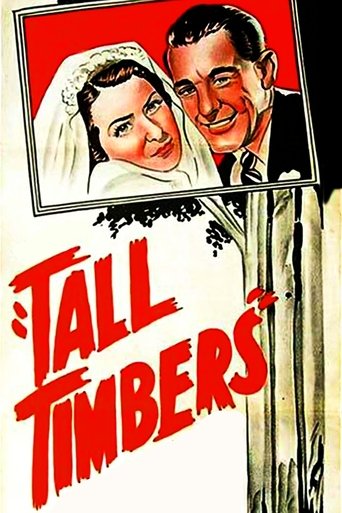
Tall Timbers (1937)
A young forestry graduate, Jim Thornton, is involved in a race between timber companies to fill a major contract. Jim has joined the crew of a genial timber baron, Burbridge, and foils attempts by a rival, Blake, to sabotage their work. J. Alan Kenyon's special effects are the highlights of the film with comic relief provided by Joe Valli as a Scottish timber-train driver amorously pursued by a shrill-voiced maid of the Burbridge's country house.
- Erscheinungsdatum
- 1937-08-03
- TMDB
- 7.0 / 10 (1)
- Laufzeit
- 1 Std. 19 Min.
- Genres
- Abenteuer
- Regie
- Ken G. Hall
Besetzung
- Frank Leighton — Jim Thornton
- Ann Richards — Joan Burbridge (as Shirley Ann Richards)
- Campbell Copelin — Charles Blake
- Frank Harvey — Darley
- Harvey Adams — Stephen Burbridge
- Aileen Britton — Claire Darley
- Ron Whelan — Ludwig Rich
- Joe Valli — Scotty
- George Lloyd — Bill
- Letty Craydon — Rosanna
- W. Lane-Bayliff — Gavan
- Peter Dunstan — Robbie
Wissenswertes
Tall Timbers is a 1937 action melodrama set in the timber industry directed by Ken G. Hall and starring Frank Leighton and Shirley Ann Richards. It has been called "easily one of the best Australian films of the 1930s, a tribute to the skill of Hall and the team at Cinesound."
Production
Cinesound Productions had intended to make a film of the timber industry since its formation in 1932. In 1935 they announced they were going to make a big screen adaptation of the William Hatfield story Big Timber as their next film after Thoroughbred (1936), starring an imported Hollywood actor. However Cinesound made Orphans of the Wilderness and It Isn't Done instead.
Eventually Hall decided not to adapt Hatfield's story, which the author later turned into a novel. He instead used an original story by Frank Hurley also set in the timber industry. This story was rewritten by Frank Harvey. Hall said the film:
All arose out of conversation I had with a friend of mine who had a property up on the north coast. He told me about a timber drive – how they got rid of a hillside of timber by half cutting the trees, then dropping the back row as "killers". This is usually how a film evolved with me. I got a climax first, then worked back. Almost always. And I think this is the thing to do.
Hall claims the script had no connection with the 1926 Australasian Films picture Tall Timber, which he had never seen although he said "Bert Cross, who was with me all this time right through the Cinesound period, often spoke of it. It was a film that had not done well, and which, unfortunately for Longford, had failed about the time he was looking to come back to Greater Union Theatres as the boss man."
It has been argued that the story has several similarities with The Squatter's Daughter, an earlier movie of Hall's. Filmink staged it has "the same feisty heroine, rugged hero with a past, nasty business rivals, tragic love subplot, comic servants, villainous servant, action finale, etc."
Auf Wikipedia weiterlesen · Text aus Wikipedia, CC BY-SA 4.0. Daten aus Wikidata.
Empfohlen
- Sie möchten Giganten sein 1971 · ★ 6.9
- Ruf der Wildnis 1972 · ★ 6.1
- Jack Hunter und die Suche nach dem Grab des Pharao 2008 · ★ 6.2
- Die Unerschrockenen 1968 · ★ 6.3
- Davy Crockett, König der Trapper 1955 · ★ 6.4
- Die Todesbucht von Louisiana 1953 · ★ 6.0
- The Warrior's Way 2010 · ★ 6.6
- Wolfsblut II - Das Geheimnis des weißen Wolfes 1994 · ★ 6.9
- Maidentrip 2014 · ★ 7.1
- Beast - Jäger ohne Gnade 2022 · ★ 6.5
- The 355 - Absolute Geheimsache 2022 · ★ 6.0
- Pecos Bill 1995 · ★ 6.2