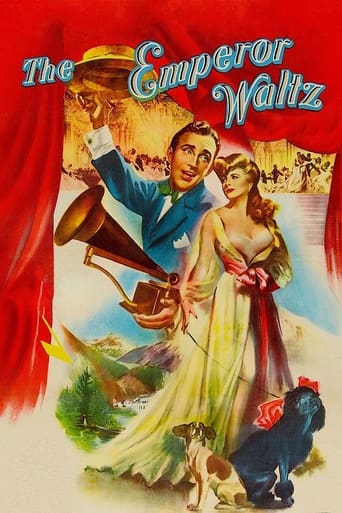
The Emperor Waltz (1948)
Bing hits the high notes! Joan hits the love notes! You'll hit a happy note... in this king-sized muscial wonder!
A brash American gramophone salesman tries to get Emperor Franz Joseph's endorsement in turn-of-the-century Austria.
- Date of release
- 1948-07-02
- TMDB
- 6.2 / 10 (31)
- Runtime
- 1h 46m
- Genres
- Romance, Comedy, Music
- Director
- Billy Wilder
Casting
- Bing Crosby — Virgil Smith
- Joan Fontaine — Johanna Augusta Franziska
- Roland Culver — Baron Holenia
- Lucile Watson — Princesse Bitotska
- Richard Haydn — l'empereur François-Joseph
- Harold Vermilyea — Chamberlain
- Sig Ruman — Dr. Zwieback
- Julia Dean — Archduchess Stephanie
- Bert Prival — Chauffeur
- Alma Macrorie — Inn Proprietress
- Roberta Jonay — Chambermaid
- John Goldsworthy
Interesting facts
- Filmed in: Alberta
- Awards: 0 · Nominations: 2
The Emperor Waltz is a 1948 American musical film directed by Billy Wilder, and starring Bing Crosby and Joan Fontaine. Written by Wilder and Charles Brackett, the film follows a brash American gramophone salesman in Austria at the turn of the twentieth century who tries to convince Emperor Franz Joseph to buy a gramophone so the product will gain favor with the Austrian people. The Emperor Waltz was inspired by a real-life incident involving Franz Joseph I of Austria. Filmed in Jasper National Park in Canada, The Emperor Waltz premiered in London, Los Angeles, and New York in the spring of 1948, and was officially released in the United States on July 2, 1948.
Production
Following the release of The Lost Weekend in late 1945, Billy Wilder and Charles Brackett began to collaborate on a film about the problems faced by American military personnel stationed in Europe following World War II. Wilder went to Europe to research the project, but his visits to the concentration camps so disturbed him he returned to Hollywood determined to write and direct a musical comedy instead.
Principal photography began in Jasper National Park in the Canadian Rockies in the province of Alberta in June 1946. It cost the studio $20,000 to have pines shipped from California and planted on location because Wilder was unhappy with the look of the native trees. He also planted 4,000 white daisies dyed blue so they would photograph better.
Working with Bing Crosby proved to be problematic from the start. Between scenes he barely interacted with leading lady Joan Fontaine, on loan from RKO Radio Pictures, who later recalled: "Crosby wasn't very courteous to me ... There was never the usual costar rapport. I was a star at that time, but he treated me like he'd never heard of me." The singer tended to ignore his director as well.
The Canadian weather proved to be uncooperative, Fontaine was ill for a period of time, and at one point Wilder underwent minor surgery. As a result, the film ran over schedule and budget, and Wilder ran into problems during post-production. It was his first color film, and he was dissatisfied with the way the exteriors had been photographed in Technicolor.
Wilder later confessed, "The picture didn't come out what I wanted ... I was looking back at my childhood in Austria—waltzes, Tyrolean hats, cream puffs—shutting out what came later", a reference to the war-torn Vienna he visited prior to the film's start. "I would like to have done the picture as a tribute to Lubitsch. A tribute to Lubitsch, it was not."
Read on Wikipedia · Text from Wikipedia, CC BY-SA 4.0. Data from Wikidata.
Recommended
- The Pirate 1948 · ★ 6.5
- Let's Make Love 1960 · ★ 6.4
- Love, Weddings & Other Disasters 2020 · ★ 6.0
- How to Marry a Millionaire 1953 · ★ 6.8
- Sneakerella 2022 · ★ 5.9
- Love Is in the Air 2023 · ★ 6.2
- The Big Store 1941 · ★ 6.3
- Arlo the Alligator Boy 2021 · ★ 6.8
- Champagne Problems 2025 · ★ 6.0
- Marry Me 2022 · ★ 6.6
- Love Happy 1949 · ★ 5.8
- My Little Pony: Equestria Girls - Legend of Everfree 2016 · ★ 7.5