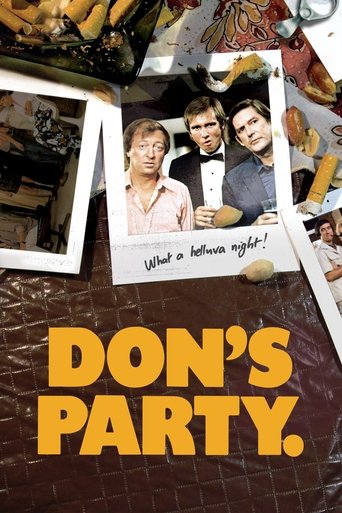
Don's Party (1976)
What a helluva night!
On the night of the 1969 federal election, Don Henderson invites a group of friends to celebrate a predicted Labor Party victory, much to the dismay of his wife, Kath. The Hendersons and their nine guests drink, joke, make love, and fight, all while coming to terms with their individual struggles in life.
- Date of release
- 1976-11-10
- TMDB
- 5.5 / 10 (26)
- Runtime
- 1h 30m
- Genres
- Comedy
- Director
- Bruce Beresford
Casting
- John Hargreaves — Don Henderson
- Graham Kennedy — Mack
- Ray Barrett — Mal
- Clare Binney — Susan
- Graeme Blundell — Simon
- Pat Bishop — Jenny
- Jeanie Drynan — Kath
- Harold Hopkins — Cooley
- Veronica Lang — Jody
- Candy Raymond — Kerry
- Kit Taylor — Evan
- Bruce Beresford — Shop Attendant
Interesting facts
- Box office: A$871K
- Budget: A$270K
- Earned 3.2× its budget
- Awards: 6 · Nominations: 7. Including: Australian Film Institute Award for Best Screenplay; AACTA Award for Best Actress in a Supporting Role; AACTA Award for Best Actress in a Leading Role; AACTA Award for Best Direction
Don's Party is a 1976 Australian black comedy film directed by Bruce Beresford from a screenplay by David Williamson, based on Williamson's 1971 play Don's Party. John Hargreaves plays Don Henderson with Jeanie Drynan as Don's wife Kath. Ray Barrett plays Mal, Don's mentor, and Pat Bishop is his wife. Graham Kennedy plays Mack, Graeme Blundell is the Liberal supporter and Veronica Lang his obedient wife. Kerry is the attractive and assertive artist and Evan is her uptight and possessive partner. Cooley comes with his young girlfriend Susan.
Production
In 1973 Phillip Adams was approached to make the film by Jack Lee, who wanted to direct. At the time Adams felt that comedies were the only genre of film likely to redeem themselves financially in Australia, so he felt he would easily be able to raise finance for the movie, which he did not think would cost more than $300,000.
Problems then emerged when the director Lee wanted to make the film into a broader comedy, which made Williamson uncomfortable and Adams was worried about raising finance with Lee attached, so Lee pulled out. Adams approached Ken Hannam but he lacked sympathy for the characters and found them too aggressive. Tim Burstall and Peter Weir were approached but they also turned down the film. Eventually Adams approached Bruce Beresford, who agreed.
There was some discussion that the events of the play be updated to the 1975 Federal election, but in the end it was decided to keep the screenplay faithful to the original play as it was widely believed in 1975 that Labor would lose–which was not the case in 1969. The setting was relocated to Sydney, in part because it was felt it would be cheaper but also to ensure audiences did not feel the movie was "too Melbourne".
Adams wanted to cast Paul Hogan as Cooley but the actor declined. Ray Barrett had played that role in London but was considered too old to do it on film, and was given the part of Mal instead. He was changed from being an ex-student to a lecturer to allow for his age. Graeme Blundell took the role of an accountant in order to escape typecasting as Alvin Purple. (Blundell had produced the original play in 1971.)
Barry Crocker was originally meant to play Don but was replaced by John Hargreaves. Hargreaves later claimed this took place at short notice when Crocker 'broke his back... the day before rehearsals'.
Read on Wikipedia · Text from Wikipedia, CC BY-SA 4.0. Data from Wikidata.
Recommended
- Spa Weekend 2026 · ★ 6.5
- Babes 2024 · ★ 6.0
- Seriously Single 2020 · ★ 6.8
- Old Dads 2023 · ★ 6.2
- Chris D'Elia: Man on Fire 2017 · ★ 6.2
- Eddie Izzard: Dress to Kill 1999 · ★ 7.8
- The Climb 2020 · ★ 6.1
- 29th Street 1991 · ★ 6.9
- Fun with Dick and Jane 1977 · ★ 6.6
- Jim Jefferies: Freedumb 2016 · ★ 7.2
- Taking Care of Business 1990 · ★ 6.3
- Pretty Persuasion 2005 · ★ 5.8