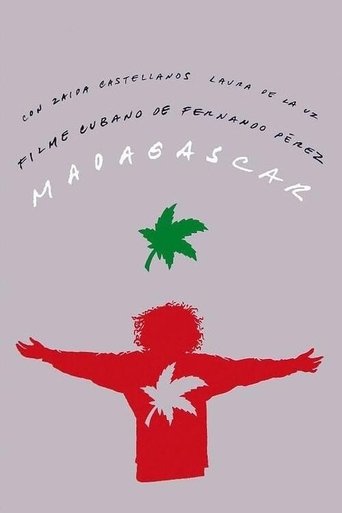
Madagascar (1995)
The 50-minute "Madagascar" has the resonance and eloquence of the best poetry, as it deftly turns an adolescent's search for identity into a metaphor for socialist Cuba. Laura is a professor at a shabby, stultifying college. Her daughter, Laurita, stops going to school, wishes to move to Madagascar and quickly races through several phases. One day, she looks like a heavy-metal fan, another like a bohemian who weeps at poetry and art. Slowly, she crosses the line from ordinary adolescent confusion to intense neurosis and beyond, finally becoming so obsessed with religion and good works that she brings 10 homeless children into the cramped house she shares with her mother and grandmother.
- Data di uscita
- 1995-03-01
- TMDB
- 6.5 / 10 (8)
- Durata
- 54 min
- Generi
- Dramma
- Regista
- Fernando Pérez
Cast
- Zaida Castellanos — Laura
- Laura de la Uz — Laurita
- Elena Bolaños — Abuela
- Jorge Molina — Molina
- Ramón Brito — Alberto
- Susana Alonso — Mercedes
- Yolanda Ruiz — Profesora I
- Carmen Rivera — Profesora II
- Nancy Rodriguez — Profesora III
- Roberto Delgado — Catedrático
- Jose Ramon Vigo — Inspector
- Basilio Garcia — Basilio
Curiosità
Madagascar is a 1994 Cuban film that marked Fernando Pérez's change of direction into a more lyrical approach to filmmaking, somehow stripped from the realistic documentary feel of his early work. The film chronicles the relationship and lack of communication between a mother and daughter during the Cuban economic crisis known as the Special Period.
Background and plot synopsis
Madagascar was originally conceived as the first part of a trilogy to be entitled 'Pronóstico del tiempo' ("Weather Prediction"). The production and post-production of director Fernando Pérez's third fiction film was completed in September 1993 to await the preparation of the work's other two parts: 'Melodrama' ("Melodrama," dir. Rolando Díaz) and 'Quiéreme y verás' ("Love me and you’ll see," dir. Daniel Díaz Torres).
Madagascar was inspired by the 1984 Mirta Yáñez short story "Beatles contra Duran Duran" ("Beatles Against Duran Duran"). The story chronicles the relationship between the narrator, who is a single mother and pragmatic middle-aged professor of physics, and her moody adolescent daughter.
The main characters' opposing personalities form the focal points of the film's narrative, which becomes a sort of psychological travelogue. During the opening sequence, we learn that Laura's life has entered into a mysterious psychological crisis, exacerbated by her daughter's extreme behavior. In an opening monologue, she tells us that she has lost the ability to dream anything different from what she experiences in her daily life.
Laura and Laurita live together with Laura's elderly mother (Elena Bolaños), and are accompanied by a reticent young painter known only as Molina (Jorge Molina) who appears to have befriended Laurita. Throughout the film, the family moves often, changing homes four times. The film has the episodic quality of a road movie as much of the exposition thus takes place in the midst of the family's relocations.
The creators of the film bore the circumstances of its production admirably well. Prior to the collapse of the Soviet Union, ICAIC had imported all of its film and development chemicals from the USSR and its economic allies. The lack of chemicals on the island after 1991 forced Madagascar’s production unit to mail all of their negatives to a lab in Venezuela, making "dailies," or the practice of reviewing each day's shooting and then re-filming w…
Leggi su Wikipedia · Testo da Wikipedia, CC BY-SA 4.0. Dati da Wikidata.
Consigliati
- Prayers for the Stolen 2021 · ★ 7.6
- Lorelei 2020 · ★ 6.0
- Gli effetti dei raggi gamma sui fiori di Matilde 1972 · ★ 7.3
- Due emisferi 2025 · ★ 7.4
- Identifying Features 2020 · ★ 7.0
- Until the End of the World 2026 · ★ 8.1
- Un traduttore 2019 · ★ 6.8
- The King of Havana 2015 · ★ 7.0
- The Chosen Ones 2015 · ★ 6.3
- La verità su Emanuel 2013 · ★ 6.0
- Most 2003 · ★ 7.3
- Kamchatka 2002 · ★ 6.7