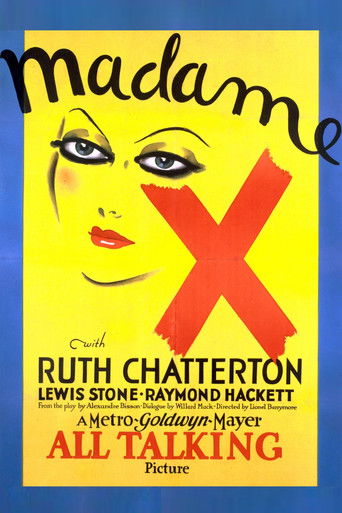
Madame X (1929)
A young, unfaithful wife and mother is thrown out by her cold, unforgiving husband, the Attorney General of France. She is barred from ever seeing her three year old son again despite her earnest attempts to make amends. For many years the mother seeks refuge overseas and in Absinthe. In the end, her son, a young and promising lawyer unknowingly defends her in court. Ruth Chatterton gives a marvelous performance in this early talkie in her portrayal of Madame X.
- 公開日
- 1929-08-17
- TMDB
- 6.3 / 10 (10)
- 上映時間(分)
- 1時間35分
- ジャンル
- ドラマ
- 監督
- ライオネル・バリモア
キャスト
- Ruth Chatterton — Jacqueline Floriot
- Lewis Stone — Louis Floriot
- Raymond Hackett — Raymond Floriot
- Sidney Toler — Dr. Merivel
- Carroll Nye — Darrell, a Naval Officer
- Eugenie Besserer — Rose, Floriot's Servant
- Chappell Dossett — Judge
- Claude King — Valmorin, the Prosecutor
- Richard Carle — Perissard
- John P. Edington — Doctor
- Mitchell Lewis — Colonel Hanby
- Holmes Herbert — Noel
豆知識
- 受賞:0 · ノミネート:2
Madame X is a 1929 American pre-Code drama film directed by Lionel Barrymore and starring Ruth Chatterton as a fallen woman who longs to be reunited with her son. The film is based on the 1908 play Madame X by French playwright Alexandre Bisson (1848–1912).
Production
The story had been filmed in 1920 by Goldwyn Pictures with Pauline Frederick in the lead role. When Goldwyn merged with two other film studios to become MGM in 1924, the studio inherited the screen rights to the story.
No music is heard under the opening or closing credits of Madame X, as studios at the time expected local theater musicians to provide live accompaniment to the credits. Because keyboardists and orchestras were still working in the theaters in the late 1920s providing music for silent films still in distribution, live music was seen as a way to make the screening more of a special event and not a purely canned presentation.
Barrymore consciously avoided the song-and-dance formula that dominated early sound pictures, treating Madame X as a dramatic play. To emphasize the film's credentials as a serious drama and avoid any music-hall associations, MGM premiered the film in New York City's Sam H. Harris Theater, a legitimate stage venue that was rented for the occasion.
Wikipediaで続きを読む · テキストはWikipedia、CC BY-SA 4.0。データはWikidata。
おすすめ
- 母の旅路 1966 · ★ 6.5
- No Man of Her Own 1950 · ★ 6.9
- 私は告白する 1953 · ★ 7.1
- Witness to Murder 1954 · ★ 6.3
- The File on Thelma Jordon 1949 · ★ 6.5
- 落とし穴 1948 · ★ 6.8
- 暴力行為 1949 · ★ 6.9
- デッドロック 1955 · ★ 7.0
- さらばベルリンの灯 1966 · ★ 5.9
- ジャンヌ・ダーク 1948 · ★ 6.2
- 裸の町 1948 · ★ 7.2
- 青い戦慄 1946 · ★ 6.7