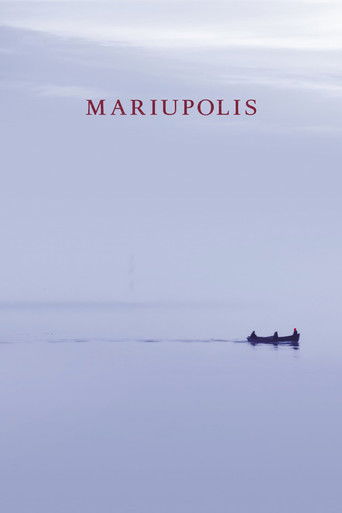
Mariupolis (2016)
The city of Mariupolis is by the Azov sea. It is also on the river Kalmius. Most of the city’s residents, half a million according to the last census, are working for the steel factory and do fishing, for leisure or food, in between shifts. The orthodox church towers above the city and its newly build bronze domes are sitting next to it, waiting to be donned. A tent near by is sheltering a crying icon, which receives a steady flow of visitors.
- Date of release
- 2016-04-08
- TMDB
- 6.6 / 10 (14)
- Runtime
- 1h 36m
- Genres
- Documentary
- Director
- Mantas Kvedaravičius
- Collection
- Mariupolis Collection
Interesting facts
- Filmed in: Mariupol
Mariupolis is a 2016 feature-length documentary by Lithuanian director Mantas Kvedaravičius. The film was shot in the autumn of 2015 in Mariupol and aimed to portray what has been described as "the testimonies of Ukrainians, captured on film and mobile phone cameras, and[...]images of despair and anxiety, destroyed settlements and lives that prove that the war has been going on since 2014."
Production
Not originally intended to be a standalone documentary, Kvedaravičius had originally traveled to Odesa and Mariupol to develop a script for a different feature film. During his travels, Kvedaravičius became intrigued by the atmosphere present in Mariupol, ultimately shifting his focus to capturing the city's daily routines before it was permanently altered.
Wary of the threat that Russia posed to the city, the film crew spent two weeks preparing for shooting. Subsequently, they shot for one month until May 9 when the city was rumored to be attacked, noted also as the day for traditional Ukrainian Victory Day festivities. This rumor proved false and multiple reshoots occurred in the following weeks. Despite this, most of the footage was filmed in that month.
The film was largely edited by Dounia Sichov in Paris and Vilnius and focused on a non-linear structure for the film, aiming to reflect life in Mariupol, where the threat of war is constant and life is unpredictable. The sound design, headed by Artūras Pugačiauskas, omitted a traditional musical score purposefully in an effort to rely on ambient city sounds.
The film was also a multi-national co-production involving Studio Uljana Kim (Lithuania), Twenty Twenty Vision (Germany), Rouge International (France), and 435 Films (Ukraine) and receiving support from the Lithuanian Film Centre (LFC) and Eurimages.
Read on Wikipedia · Text from Wikipedia, CC BY-SA 4.0. Data from Wikidata.
Recommended
- 20 Days in Mariupol 2023 · ★ 8.1
- 2000 Meters to Andriivka 2025 · ★ 8.1
- My Mom Jayne 2025 · ★ 7.9
- S4: The Bob Lazar Story 2026 · ★ 8.4
- Heart of a Dog 2015 · ★ 6.5
- I Am Heath Ledger 2017 · ★ 7.4
- 42 Up 1999 · ★ 7.6
- Come See Me in the Good Light 2025 · ★ 7.1
- The Captains 2011 · ★ 6.4
- Avatar: The Deep Dive - A Special Edition of 20/20 2022 · ★ 7.2
- A Toxic Love Story 2026 · ★ 6.4
- Seduced and Abandoned 2013 · ★ 6.2