Mighty Joe Young (1949)
Merian Cooper's amazing adventure in the unusual!
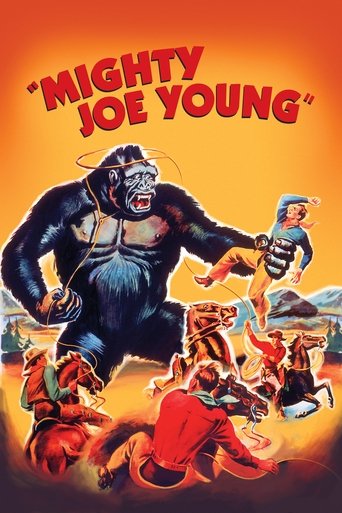
A young woman, Jill Young, grew up on her father's ranch in Africa, raising a large gorilla named Joe from an infant. Years later, she brings him to Hollywood to become a star.
- Date of release
- 1949-07-13
- TMDB
- 6.5 / 10 (130)
- Runtime
- 1h 34m
- Genres
- Adventure, Fantasy, Drama, Action
- Director
- Ernest B. Schoedsack
Casting
- Terry Moore — Jill Young
- Ben Johnson — Gregg Johnson
- Robert Armstrong — Max O'Hara
- Frank McHugh — Windy
- Douglas Fowley — Jones
- Denis Greene — Crawford
- Paul Guilfoyle — Smith
- Nestor Paiva — Brown
- Regis Toomey — John Young
- Lora Lee Michel — Jill (as a child)
- James Flavin — Schultz
- Mary Field — Secretary (uncredited)
Interesting facts
- Box office: $2M
- Budget: $1.8M
- Earned 1.1× its budget
- Awards: 1 · Nominations: 1. Including: Academy Award for Best Special Effects
Mighty Joe Young is a 1949 American fantasy film distributed by RKO Radio Pictures and produced by the same creative team responsible for King Kong (1933). The black-and-white film was produced and directed by Merian C. Cooper and Ernest B. Schoedsack, and written by Ruth Rose. It stars Robert Armstrong, Terry Moore, and Ben Johnson in his first credited screen role. Animation effects were handled by Willis O'Brien, Ray Harryhausen, Pete Peterson, and Marcel Delgado. It was released on July 13, 1949, and underperformed at the box office, though reviews were generally positive. In 1950, the film won an Academy Award for special effects.
Production
Mighty Joe Young was produced by Arko, a company formed by John Ford and Merian C. Cooper and owned by RKO and Argosy Pictures. Arko was formed solely for making Mighty Joe Young. John Ford was credited as a co-producer of the film, but left before shooting began. Though Cooper originally conceived of the story, he may have taken inspiration from Toto and I by Augusta Maria Hoyt.
As production progressed with a budget between $1.2 and $1.5 million, Ernest Schoedsack and Willis O'Brien contributed to the storyline, while Schoedsack's wife, Ruth Rose, wrote the screenplay. She based the characters Gregg and O'Hara on her husband and Cooper, respectively. In planning the film, Cooper aimed for a lighthearted reflection of King Kong.
While Mighty Joe Young was in its conception stages in 1945, production designer Willis O'Brien, with Cooper's approval, hired a young man named Ray Harryhausen with whom he had been acquainted for several years. Harryhausen was fascinated by the stop-motion animation in King Kong and had experimented with stop-animation films of his own, showing them to O'Brien, to whom he looked up as a mentor.
With the film's approval, O'Brien and Harryhausen moved to an RKO studio in Culver City, where they were able to officially begin production. O'Brien was given a special effects team of 47 people. O'Brien felt that he did not need a team that large, but Hollywood union rules stated that different jobs needed to be done by different people. As a result, the film cost more to make than it would have with a smaller team.
Joe was animated using posable figures modeled after real gorillas. Each model, made of an aluminum-copper skeleton with 150 pieces, cost nearly $1500. Harryhausen designed the armature with ball-and-socket joints; early models were designed with hinge joints. Using ball-and-socket joints allowed for increased natural joint movement though they required frequent repairs. Engineer Harry Cunningham was put in charge of assembling the armature.
Read on Wikipedia · Text from Wikipedia, CC BY-SA 4.0. Data from Wikidata.
Recommended
- Mighty Joe Young 1998 · ★ 6.3
- Kingdom of the Planet of the Apes 2024 · ★ 7.0
- King Kong 2005 · ★ 6.9
- The Jungle Book 2016 · ★ 6.9
- WWE Royal Rumble 2006 2006 · ★ 7.9
- Mowgli: Legend of the Jungle 2018 · ★ 6.5
- Black Panther 2018 · ★ 7.4
- The Legend of Tarzan 2016 · ★ 5.9
- Godzilla x Kong: The New Empire 2024 · ★ 7.0
- Krull 1983 · ★ 6.1
- Welcome to Smelliville 2021 · ★ 6.7
- Rampage 2018 · ★ 6.5