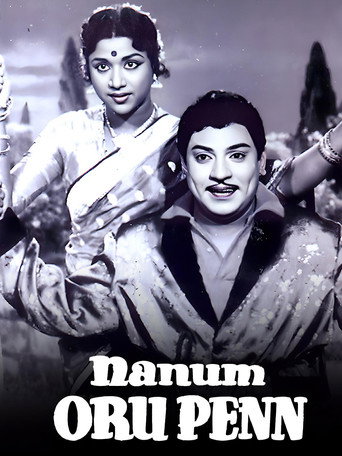
Naanum Oru Penn (1963)
The plot revolves around the dark complexioned and uneducated girl and how she convinces everyone that more than appearance and education, it is the character which is important for a woman.
- Date of release
- 1963-06-06
- TMDB
- 6.0 / 10 (1)
- Runtime
- 2h 35m
- Genres
- Drama
- Director
- A. C. Tirulokchandar
Casting
Interesting facts
Naanum Oru Penn is a 1963 Indian Tamil-language drama film directed by A. C. Tirulokchandar and written by K. P. Kottarakkara. The film stars S. S. Rajendran and R. Vijayakumari, with S. V. Ranga Rao, M. R. Radha, S. V. Subbaiah, C. K. Nagesh, Rajan and C. S. Pushpalatha in supporting roles. It revolves around an uneducated, dark complexioned girl and how she convinces everyone that character is more important for a woman than appearance and education.
Production
After watching the Bengali play Bodhu, A. V. Meiyappan of AVM Productions was impressed and decided to adapt it into a Tamil film. A. C. Tirulokchandar was selected to direct the film, titled Naanum Oru Penn. It was produced by Meiyappan's sons Murugan, Saravanan and Kumaran under Murugan Brothers, a subsidiary of AVM. Naanum Oru Penn was the second production of Murugan Brothers. The producers wanted K. P.
The crew initially wanted Gemini Ganesan and Savitri as Bhaskar and Kalyani; however Tirulokchandar was adamant and chose S. S. Rajendran and R. Vijayakumari instead. The make-up for Vijayakumari was done by Kini. Vijayakumari initially had apprehension of portraying the character since many people warned her not to spoil her career by doing this character, but Sivaji Ganesan encouraged her to act in this film.
The song "Yemara Sonnadhu" was shot at main road of Vidhan Soudha, Bangalore with Karnataka Assembly building in the background. It was later reshot at Vijaya Garden in Madras as the Censor Board objected to the scene where Rajan and Pushpalatha's characters are shown dancing in NCC costumes.
While discussing the ending, the team felt this film's end should be tragic with S. V. Ranga Rao and Vijayakumari's characters dying as they felt Pasamalar (1961) succeeded because of its tragic climax and wanted to repeat it; however Meiyappan decided to have a happy ending as he wanted Vijayakumari's character to lead a happy life.
Read on Wikipedia · Text from Wikipedia, CC BY-SA 4.0. Data from Wikidata.
Recommended
- Gracie 2007 · ★ 6.2
- Skin 2009 · ★ 6.4
- Kisses 2008 · ★ 7.1
- Hardball 2001 · ★ 6.5
- The Girl in the Book 2015 · ★ 5.8
- Charm City Kings 2020 · ★ 7.8
- Bastard Out of Carolina 1996 · ★ 7.1
- Skater Girl 2021 · ★ 7.2
- Salomé 2013 · ★ 6.1
- What Maisie Knew 2013 · ★ 7.1
- The Young One 1960 · ★ 7.0
- The Nest 2020 · ★ 6.1