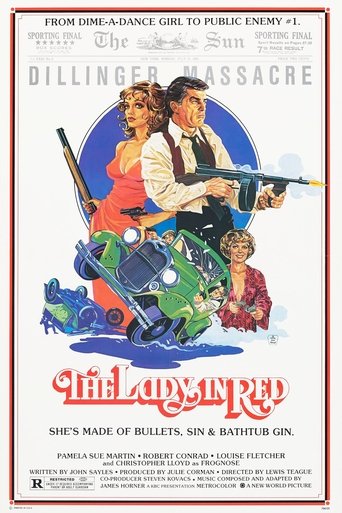
Die Frau in Rot (1979)
The Lady in Red
Das Leben der Predigertochter Polly Franklin ändert sich schlagartig, als sie einem Banküberfall von John Dillinger beiwohnt. Danach wird sie erst von einem Reporter entjungfert, der sie mit einer Zeitungsgeschichte ködert, und dann von ihrem Vater rausgeschmissen. Sie macht sich auf den Weg nach Chicago, um dort auf eigenen Füßen zu stehen. Aber die Depression hält nicht viele Chancen bereit uns so landet sie nach einigen Umwegen erst im Knast und dann schließlich im Edelbordell der rumänischen Exilantin Anna Sage wo der Mob ein und aus geht. Als Anna die Ausweisung droht, ergreift sie ihre letzte Chance, im Land bleiben zu können: Denn sie hat Pollys große Liebe – einen vermeintlichen Geschäftsmann – als Staatsfeind Nr. 1 John Dillinger erkannt...
- Erscheinungsdatum
- 1979-07-01
- TMDB
- 5.6 / 10 (49)
- Laufzeit
- 1 Std. 33 Min.
- Genres
- Action, Krimi, Liebesfilm, Drama
- Regie
- Lewis Teague
Besetzung
- Pamela Sue Martin — Polly Franklin
- Robert Conrad — John Dillinger
- Louise Fletcher — Anna Sage
- Robert Hogan — Jake Lingle
- Laurie Heineman — Rose Shimkus
- Glenn Withrow — Eddie
- Rod Gist — Pinetop
- Peter Hobbs — Pops Geissler
- Christopher Lloyd — Frognose
- Dick Miller — Patek
- Nancy Parsons — Tiny Alice
- Alan Vint — Melvin Purvis
Wissenswertes
- Budget: 900.000 $
The Lady in Red is a 1979 American crime drama film directed by Lewis Teague with a screenplay by John Sayles for Roger Corman's New World Pictures. The film stars Pamela Sue Martin and Robert Conrad, and Louise Fletcher. The plot concerns a farmer's daughter who runs away to Chicago, where she falls into a life of crime through association with gangster John Dillinger. It was based on the life of Polly Hamilton, although heavily fictionalised.
Production
John Sayles had previously written Piranha (1978) for producer Roger Corman which had done very well critically and commercially. Corman wanted Sayles to write another script for him at New World Pictures. Sayles said Corman told him he wanted "a female Godfather story about the woman who was with John Dillinger when he was shot” and that was all.
Corman had previously made some successful female-orientated gangster films set in the 1930s, Bloody Mama (1970) and Big Bad Mama (1974). He asked Sayles for a treatment. According to Sayles:
I wanted to do more than I knew Roger Corman wanted to do with that script. He basically wanted Bloody Mama Part Three; I wanted to get into other things about the thirties. So I said, “Roger, I will not write you a treatment, I’ll write you a full draft.” And that way I was able to show him things that, if I had just said, “I wanna go into this area, I wanna take her to jail, take her to a sweatshop,” he’d say, “Oh no, that’s beside the point”;…
Sayles was interested in 1930s Chicago and admired the television series The Untouchables; he also read many novelists from that era such as James T. Farrell and Ring Lardner and watched early talking pictures. Sayles wrote a full screenplay which he called "one of the best scripts I've written. He said the film "tried to be about" was:
Why Dillinger and the FBI were shooting each other. To me, Dillinger was just a PR job. J. Edgar Hoover made stars out of the guys he knew he could catch. He never got anybody from the Mafia. In other words, to me that movie was about why Dillinger became Public Enemy No. 1 at a time when one-third of the women in Chicago between the ages of 15 and 35 were working as prostitutes.
Auf Wikipedia weiterlesen · Text aus Wikipedia, CC BY-SA 4.0. Daten aus Wikidata.
Empfohlen
- The Enforcer 2022 · ★ 7.0
- The Double - Eiskaltes Duell 2011 · ★ 5.8
- Silverton Siege 2022 · ★ 6.3
- Convict 2014 · ★ 6.5
- Fast Charlie 2023 · ★ 6.3
- Eifersucht 2024 · ★ 5.8
- Supercross 2005 · ★ 6.3
- One Mile: Kapitel 2 2026 · ★ 6.6
- Imperium - Zwei Welten prallen aufeinander 2002 · ★ 6.2
- Blue Story - Gangs of London 2019 · ★ 7.3
- Das Quiller Memorandum - Gefahr aus dem Dunkel 1966 · ★ 5.9
- Al Capone 1959 · ★ 6.6