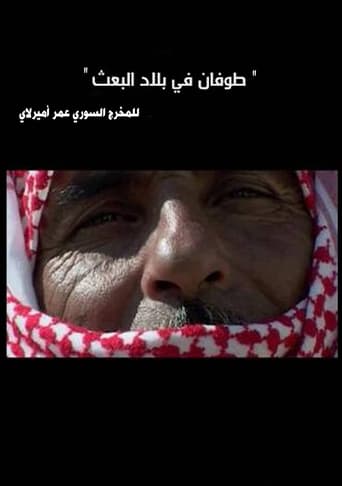
طوفان في بلاد البعث (2003)
A look at the Baath party's project to construct a system of dams.
- Data lansării
- 2003-04-23
- TMDB
- 7.1 / 10 (7)
- Durată
- 46 min
- Genuri
- Documentar
- Regizor
- Omar Amiralay
Curiozități
A Flood in Baath Country is a Syrian documentary film by the director Omar Amiralay, released in 2003 and premiered in 2004 at the Beirut Cinema Days Festival. The film, Amiralay's last, criticizes the Ba'athist regime in Syria, particularly the Tabqa Dam construction project and the party's impact on political life and education in the country. In A Flood in Baath Country, Amiralay repurposes footage from his first film to criticize his initial enthusiasm for the Ba'ath Party. Footage for the documentary was shot in the Syrian village of al-Mashi and on Lake Assad.
Background and production
In his first film, Film Essay on the Euphrates Dam (1970), Omar Amiralay had supportively documented the Ba'ath Party's construction of the Tabqa Dam on the Euphrates. In the river's damming, Lake Assad was formed as the dam's reservoir, flooding archaeologically important villages and displacing their inhabitants. New settlements around the reservoir were constructed for the displaced villagers.
When doing research for A Flood in Baath Country, Amiralay came to believe that the dam was not constructed to generate power, but to protect the regime from the possibility that Turkey would restrict Syria's water supply. He was also particularly incensed to learn that the site submerged by Lake Assad was "the place where human beings became farmers for the first time, and left the hunting-and-gathering stage, eleven thousand years before Christ…
Speaking to Lawrence Wright, Amiralay described the film's working concept: "I wanted to make a film of fifteen shots, which are the fifteen reasons I hate the Ba'ath Party. The last reason was that I hate myself, for having been obliged to make a film for them.
Amiralay was pondering producing the film with the General Film Organization, but Syrian director and photographer Mohamad al-Roumi encouraged him to make it himself, and offered all of his own equipment for Amiralay to use. Al-Roumi also helped Amiralay to film in the region despite not having the necessary approvals. Amiralay continued shooting without al-Roumi when the latter traveled to France.
Citește pe Wikipedia · Text din Wikipedia, CC BY-SA 4.0. Date din Wikidata.
Recomandate
- A Toxic Love Story 2026 · ★ 6.4
- Avatar: incursiune în culise, editie specială 2020 2022 · ★ 7.2
- Marvel Studios Assembled: The Making of Hawkeye 2022 · ★ 7.2
- Above Majestic 2018 · ★ 7.4
- Heart of a Dog 2015 · ★ 6.5
- McQueen 2018 · ★ 7.4
- The Class of ‘92 2013 · ★ 7.1
- Blestemul Dragonului 1993 · ★ 7.2
- Din culisele serialului Jocul calamarului: Provocarea 2023 · ★ 8.0
- No Half Measures: Creating the Final Season of Breaking Bad 2013 · ★ 8.5
- Fuck 2006 · ★ 6.4
- Ex Libris: The New York Public Library 2017 · ★ 6.4