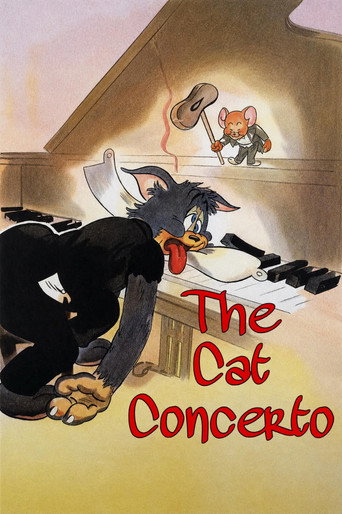
The Cat Concerto (1947)
Poor Jerry! He's hiding inside a piano when Tom gives a concert!
Tom Cat is a concert pianist who plays beautifully until he is interrupted by Jerry Mouse.
- Date of release
- 1947-04-26
- TMDB
- 7.6 / 10 (183)
- Runtime
- 8m
- Genres
- Animation, Comedy, Music
- Director
- Joseph Barbera, William Hanna
Casting
- William Hanna — Tom (voice) (uncredited)
Interesting facts
- Awards: 1 · Nominations: 1. Including: Academy Award for Best Animated Short Film
The Cat Concerto is a 1947 American animated cartoon and a Tom and Jerry short. It was released to theaters by Metro-Goldwyn-Mayer under their cartoon division on April 26, 1947. The short film centers on Tom's attempts to perform Franz Liszt's Hungarian Rhapsody No. 2 on the piano as Jerry constantly disrupts the performance, leading to an escalation of slapstick antics. The short film was produced by Fred Quimby and directed by William Hanna and Joseph Barbera, with musical supervision by Scott Bradley, and animation by Kenneth Muse, Ed Barge, and Irven Spence.
Background and production
In 1939, animator William Hanna and writer Joseph Barbera from MGM's cartoon division began working together to create a mouse-and-cat cartoon titled Puss Gets the Boot (1940), which received critical and popular acclaim along with an Academy Award nomination. The short film evolved into Tom and Jerry, which quickly became the most popular cartoon characters from MGM's cartoon division.
The Cat Concerto was directed by Hanna and Barbera, produced by Fred Quimby, and edited by Fred MacAlpin. It additionally features animation from Kenneth Muse, Ed Barge, and Irven Spence, set design from Robert Gentle, music from Scott Bradley, piano from Jakob Gimpel, and photography from Jack Stevens. The short film's production number is #165. For its use of music, Franz Liszt's Hungarian Rhapsody No. 2 is prominently featured.
In the same year that MGM produced The Cat Concerto, Warner Bros. released a similar cartoon titled Rhapsody Rabbit (1946), directed by Friz Freleng and featuring Bugs Bunny facing off against an unnamed mouse. Both cartoons shared nearly identical gags and featured the same piece by Franz Liszt.
Read on Wikipedia · Text from Wikipedia, CC BY-SA 4.0. Data from Wikidata.
Recommended
- Johann Mouse 1953 · ★ 6.9
- The Hollywood Bowl 1950 · ★ 7.2
- Symphony Hour 1942 · ★ 6.9
- Puss Gets the Boot 1940 · ★ 7.0
- I Love to Singa 1936 · ★ 6.8
- The Mouse Comes to Dinner 1945 · ★ 7.2
- The Two Mouseketeers 1952 · ★ 6.9
- A Corny Concerto 1943 · ★ 6.9
- Get a Horse! 2013 · ★ 7.6
- Little School Mouse 1954 · ★ 7.0
- The Band Concert 1935 · ★ 7.2
- Mucho Mouse 1957 · ★ 6.6