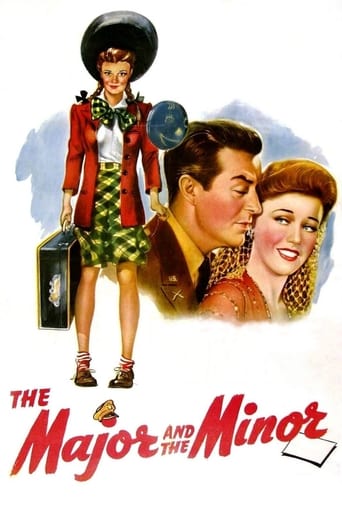
The Major and the Minor (1942)
Is she a kid - or is she kidding?
Low on funds, working-class girl Susan Applegate disguises herself as a youngster in order to pay half fare home. But little 'Sue Sue' finds herself in a whole heap of grownup trouble when she hides out in a compartment with handsome Major Philip Kirby.
- Date of release
- 1942-09-16
- TMDB
- 7.1 / 10 (155)
- Runtime
- 1h 40m
- Genres
- Comedy, Romance
- Director
- Billy Wilder
Casting
- Ginger Rogers — Susan Applegate
- Ray Milland — Major Kirby
- Rita Johnson — Pamela Hill
- Robert Benchley — Mr. Osborne
- Diana Lynn — Lucy Hill
- Edward Fielding — Colonel Hill
- Frankie Thomas — Cadet Osborne
- Raymond Roe — Cadet Wigton
- Charles Smith — Cadet Korner
- Larry Nunn — Cadet Babcock
- Billy Dawson — Cadet Miller
- Lela Rogers — Mrs. Applegate
Interesting facts
- Awards: 1 · Nominations: 0. Including: National Board of Review: Top Ten Films
The Major and the Minor is a 1942 American romantic comedy film starring Ginger Rogers and Ray Milland. It was the first American film directed by Billy Wilder. The screenplay credited to Wilder and Charles Brackett is "suggested by" the 1923 play Connie Goes Home by Edward Childs Carpenter, based on the 1921 Saturday Evening Post story "Sunny Goes Home" by Fannie Kilbourne.
Production
Wilder moved to Hollywood in 1934 shortly after directing his first film, the French language Mauvaise Graine. During the ensuing years, he and Charles Brackett had collaborated on eight screenplays, including Ninotchka and Ball of Fire, but Wilder was anxious to direct again and producer Arthur Hornblow Jr. agreed to give him a chance.
Rogers recently had won the Academy Award for Best Actress for Kitty Foyle, putting her in a position to select her own director. Agent Leland Hayward represented both Rogers and Wilder, who asked him to intercede with her on his behalf, and Brackett also urged her to meet the neophyte director. She agreed, and she and the screenwriters met during the filming of Roxie Hart.
Wilder was driving home from the studio one evening and pulled up at a red light next to Ray Milland. Impulsively, he called out, "I'm doing a picture. Would you like to be in it?," and the actor responded, "Sure." Wilder sent him the script, which Milland liked. Three years later the two men would collaborate on The Lost Weekend, which would win Oscars for both of them.
As a neophyte director, Wilder heavily relied on editor Doane Harrison for guidance. Harrison had edited Hold Back the Dawn (1941), which Brackett and Wilder had written. Unusually for an editor, Harrison was on the set for filming as well as working in the cutting room. Wilder later said, "I worked with a very good cutter, Doane Harrison, from whom I learned a great deal. He was much more of a help to me than the cameraman.
Leo Tover was the cinematographer for the film; Tover had also worked on Hold Back the Dawn. The campus of St. John's Military Academy in Delafield, Wisconsin, was used for exterior location shots. Principal photography was completed quickly and efficiently. Rogers later recalled, "We had a lot of fun making the picture. It was that kind of story. And even though it was his first film, from day one, I saw that Billy knew what to do.
Read on Wikipedia · Text from Wikipedia, CC BY-SA 4.0. Data from Wikidata.
Recommended
- Love Is in the Air 2023 · ★ 6.2
- What's Love Got to Do with It? 2023 · ★ 6.1
- Lover Come Back 1961 · ★ 7.0
- The Other End of the Line 2007 · ★ 6.5
- One Small Hitch 2013 · ★ 6.6
- Easy Virtue 2008 · ★ 6.5
- Platinum Blonde 1931 · ★ 6.6
- The Smiling Lieutenant 1931 · ★ 6.8
- Let's Make Love 1960 · ★ 6.4
- Cactus Flower 1969 · ★ 7.2
- I Love You Again 1940 · ★ 7.2
- That Uncertain Feeling 1941 · ★ 6.6