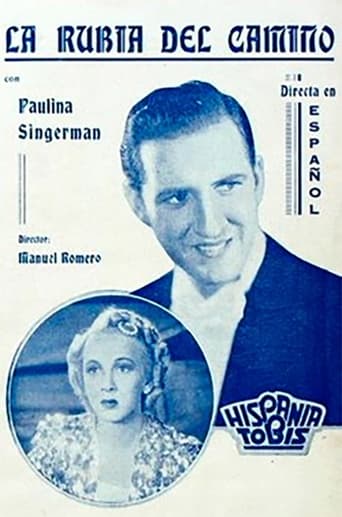
The Blonde on the Road (1938)
La rubia del camino
A very coquette millionaire girl runs away before her engagement and is courted by a truck driver.
- Date of release
- 1938-04-05
- TMDB
- 6.9 / 10 (7)
- Runtime
- 1h 10m
- Genres
- Comedy, Romance
- Director
- Manuel Romero
Casting
- Paulina Singerman — Isabel 'Betty' Costa Reina
- Enrique Serrano — Count Ugolino Malipieri
- Marcelo Ruggero — Batista
- Sabina Olmos — Lucia
- Fernando Borel — Julian Achaval
- María Esther Buschiazzo — Elvira Costa Reina
- Juan José Porta — Grandfather
- Enrique Roldán — Raul
- Mary Dormal — Inés
- Alberto Terrones — Emilio Costa Reina
- María Vitaliani — Marietta
Interesting facts
La rubia del camino is a 1938 Argentine comedy film written and directed by Manuel Romero, starring Paulina Singerman and produced by the Lumiton studio during the Golden Age of Argentine cinema. Inspired by the American screwball comedy It Happened One Night (1934), by Frank Capra, it tells the story of a wealthy, haughty young woman who runs away from her engagement party, meets a working-class truck driver during a journey and begins a romance that leads her to rethink her life and her class prejudices.
Production and style
La rubia del camino was made during a highly prolific period for Manuel Romero, who had made his debut as a director for the Lumiton production company in 1935 with Noches de Buenos Aires, with which he returned the studio to success at a moment of economic uncertainty, and soon became its principal filmmaker.
Romero is a complex figure to analyse from an auteur perspective, since he was a director driven by commercial rather than artistic ambitions, with a rudimentary use of film technique and a working method based on recurring actors and situations that he reworked and reversioned film after film.
There is consensus among historians that La rubia del camino is based on the American film It Happened One Night (1934), by Frank Capra, one of the first screwball comedies. Like Capra's film, La rubia del camino is about a rich young woman who evades parental control, meets a man of a lower class, travels with him to the city and ends up falling in love.
Singerman's persona has often led her films to be framed as an Argentine version of the American screwball comedy, although the genre's characteristic elements belong more to the character than to the structure of the film. Unlike Hollywood screwball, the formation of the cross-class couple does not amount to a "union of complementary opposites"; instead, Romero presents class difference as irreconcilable.
The reconciliation of Betty and Julian requires not only that she reject her elite urban lifestyle but also that she take on the subordinate feminine role in the couple. In this sense, the movie shares a common gender dynamic with Capra's film: in both, the capricious independent woman is eventually subordinated to the male.
Read on Wikipedia · Text from Wikipedia, CC BY-SA 4.0. Data from Wikidata.
Recommended
- Let's Make Love 1960 · ★ 6.4
- Girl on a Bicycle 2013 · ★ 5.9
- ¿Quieres ser mi hijo? 2023 · ★ 8.4
- Desperados 2020 · ★ 6.0
- Easy Virtue 2008 · ★ 6.5
- Sex Appeal 2022 · ★ 6.6
- The Prince & Me 4: The Elephant Adventure 2010 · ★ 6.1
- Splendor 1999 · ★ 6.2
- The Wedding Unplanner 2020 · ★ 6.5
- Chasing Papi 2003 · ★ 6.7
- How to Break Up with Your Douchebag 2017 · ★ 6.9
- Miles and Lies 2023 · ★ 7.1