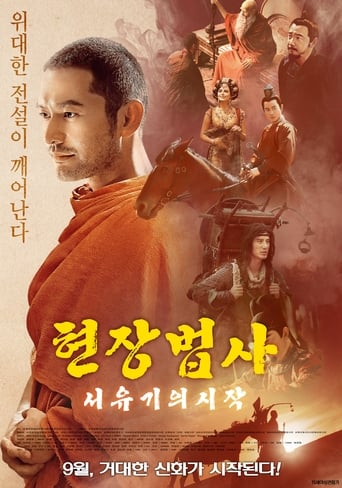
현장법사: 서유기의 시작 (2016)
大唐玄奘
당 태종 시기, 젊은 현장법사는 불법의 진리를 얻기 위해 위험을 무릅쓰고 국경을 넘어 서역으로 향한다. 그의 길을 막는 여러 세력과 제자의 배신, 끝없는 사막에서의 굶주림에 시달리는 등 온갖 시련을 겪는다. 하지만 불법을 향한 현장의 의지는 나날이 더 강해지고 불교의 성지라 불리는 인도의 ‘날란다’로 향한다.
출연진
- 황효명 — Xuan Zang
- 徐峥 — Li Daliang
- Bajia Pu — Shi Pan Ni
- 뤄진 — Li Chang
- 담개 — Wang Xiang
- Vivian Dawson — Wu Qing
- 連凱 — King of Gao Chang
- Jonathan Kos-Read — Cunningham
- 趙文瑄 — Emperor Taizong of Tang
- 湯鎮業 — Monk Mu Cha
- 姜超 — King of Yi Wu
- Liang Zhao — The Eunuch
흥미로운 사실
- 수상: 1 · 노미네이트: 1. 주요 수상: Huabiao Award for Outstanding Film
Xuanzang is a 2016 Chinese-Indian historical adventure film that dramatizes the life of Xuanzang (602–664), a Buddhist monk and scholar. The film depicts his arduous nearly two-decade overland journey to India during the Tang dynasty on a mission to bring Buddhist scriptures to China. The film is directed by Huo Jianqi and produced by Wong Kar-wai. It stars Huang Xiaoming as the titular character, and includes cameo or short performances by other accomplished actors including Kent Tong, Purba Rgyal, Sonu Sood and Tan Kai. It was released in China on 29 April 2016, with distribution in China by China Film Group Corporation.
Production
The film was produced by China's biggest state owned production company China Film Corporation and its Indian partner Eros International. It was a prestige project as the first agreement on joint productions was signed in the presence of Indian Prime Minister Narendra Modi and General Secretary of the Chinese Communist Party Xi Jinping in May 2015.
It was filmed on location in Turpan (including the Flaming Mountain Scenic Area), Changji, Altay, Aksu, Kashi all of which are in the Xinjiang province of China, the Gansu province of China, and India. The sets were lavish, hundreds of extras were used and 10 companies from the US and China comprising 200 people were hired for post-production.
In an interview with the Hindustan Times, translated from Chinese, the director noted that most of the shoots were outdoors. "It was physically taxing. In India, we spent 10 days in April and May and another 20 days in September... The heat and the sun were all very challenging."
The primary language spoken in the film is Mandarin. However, an important dialog between Xuanzang and his master, Śīlabhadra, is in Sanskrit. The director noted that "We spent a long time with Sanskrit scholars, both in India and Peking University, to get this right, and we had Huang Xiaoming do the lines himself".
위키백과에서 더 읽기 · 텍스트 출처: 위키백과, CC BY-SA 4.0. 데이터 출처: Wikidata.
추천
- 장안삼만리 2023 · ★ 7.6
- 더 챔피언 2022 · ★ 6.2
- 미스터 터너 2014 · ★ 6.6
- 캐서린: 헨리 8세의 마지막 여인 2024 · ★ 6.3
- 쿤둔 1997 · ★ 6.8
- 일곱 여인 1965 · ★ 6.5
- 사조영웅전: 협지대자 2025 · ★ 7.1
- 영웅 2002 · ★ 7.5
- 아티의 마지막 여정 2023 · ★ 6.6
- 필그리미지 2017 · ★ 6.0
- 자객 섭은낭 2015 · ★ 6.4
- 천하영웅 2010 · ★ 6.0