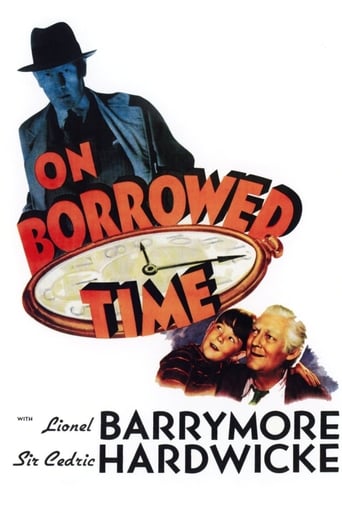
On Borrowed Time (1939)
The Great Broadway Stage Hit Reaches The Screen
Young Pud is orphaned and left in the care of his aged grandparents. The boy and his grandfather are inseparable. Gramps is concerned for Pud's future and wary of a scheming relative who seeks custody of the child. One day Mr. Brink, an agent of Death, arrives to take Gramps "to the land where the woodbine twineth." Through a bit of trickery, Gramps confines Mr. Brink, and thus Death, to the branches of a large apple tree, giving Gramps extra time to resolve issues about Pud's future.
- Date of release
- 1939-07-07
- TMDB
- 7.7 / 10 (32)
- Runtime
- 1h 39m
- Genres
- Comedy, Drama, Fantasy
- Director
- Harold S. Bucquet
Casting
- Lionel Barrymore — Julian Northrup aka Gramps
- Cedric Hardwicke — Mr. Brink
- Beulah Bondi — Nellie Northrup aka Granny
- Una Merkel — Marcia Giles
- Bobs Watson — Pud Northrup
- Nat Pendleton — Mr. Grimes
- Henry Travers — Dr. Evans
- Grant Mitchell — Mr. Pilbeam
- Eily Malyon — Demetria Riffle
- James Burke — Sheriff Burlingame
- Charles Waldron — Reverend Murdock
- Ian Wolfe — Charles Wentworth
Interesting facts
On Borrowed Time is a 1939 drama film produced by Metro-Goldwyn-Mayer starring Lionel Barrymore, with Cedric Hardwicke, Beulah Bondi, Una Merkel, and Bobs Watson in support. Produced by Sidney Franklin and directed by Harold S. Bucquet, it is adapted from Paul Osborn's 1938 Broadway hit play. The play, based on a novel by Lawrence Edward Watkin, has been revived twice on Broadway since its original run.
Production
Frank Morgan was originally slated to play Gramps, until Barrymore convinced the studio he could play the part in spite of needing a wheelchair.
The story is a retelling of a Greek fable in which Death is tricked into climbing a pear tree which had been blessed by Saint Polycarp to trap anyone who was trying to steal an old woman's pears. The opening credits assert: "Mr. Chaucer liked the story and believed it—and so do we. If, perchance, you don't believe it, we respectfully insist that we [and Mr. Chaucer] must be right.
Set in small-town America, Barrymore plays crotchety wheelchair-using Julian Northrup ("Gramps"), who smokes a pipe, cherishes his dog, prefers fishing to churchgoing, occasionally takes a nip of "tonic", and indulges in mild profanity. He is a veteran of the Civil War (observing that they told him he was too young to serve) and of the Spanish-American War (referring to being at the Battle of San Juan Hill).
Early in the film, Mr. Brink tells Gramps he is there to take him "where the woodbine twineth." This is a reference to an 1870 poem by Septimus Winner (under the pseudonym Apsley Street) euphemizing death, heaven, and the afterlife. Gramps dismissively tells Mr. Brink that's what people say to children. Gramps would have been a child himself around the 1870s, and would likely have heard that phrase in a popular song of that era.
Read on Wikipedia · Text from Wikipedia, CC BY-SA 4.0. Data from Wikidata.
Recommended
- Nanny McPhee 2005 · ★ 6.7
- The Secret Garden 2020 · ★ 6.3
- Hunt for the Wilderpeople 2016 · ★ 7.6
- Babe 1995 · ★ 6.3
- Uncle Buck 1989 · ★ 6.8
- Secondhand Lions 2003 · ★ 7.2
- Mio in the Land of Faraway 1987 · ★ 6.0
- Red Dog: True Blue 2016 · ★ 6.6
- Slumberland 2022 · ★ 7.2
- The Happiest Millionaire 1967 · ★ 6.8
- The Secret Garden 1993 · ★ 7.4
- Twitches 2005 · ★ 6.7