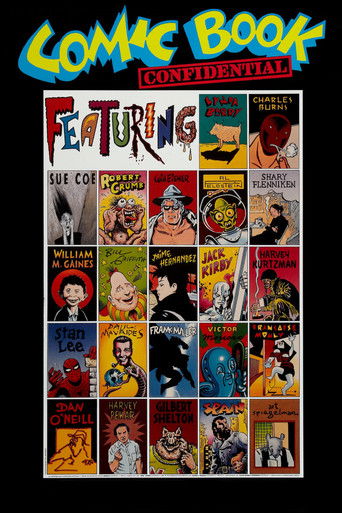
Comic Book Confidential (1989)
Ce documentaire de Ron Mann dresse le portrait de 22 grands artistes américains de la bande dessinée contemporaine. Grâce à des interviews, des images d’archives, il retrace le développement créatif de ce média populaire. Du Captain America de Jack Kirby au mouvement underground des années 60, en passant par l’irrévérence de Mad Magazine, COMIC BOOK CONFIDENTIAL explore aussi les années 80 lorsque les genres explosent au point que même les super héros ont du mal à suivre !
- Date de sortie
- 1989-06-14
- TMDB
- 6.8 / 10 (33)
- Durée
- 1 h 25 min
- Genres
- Documentaire
- Réalisateur
- Ron Mann
Distribution
- Frank Miller — Self
- Jack Kirby — Self
- Stan Lee — Self
- Will Eisner — Self
- Robert Crumb — Self
- Lynda Barry — Self
- Charles Burns — Self
- William M. Gaines — Self
- Al Feldstein — Self
- Shary Flenniken — Self
- Bill Griffith — Self
- Jaime Hernández — Self
Anecdotes
Comic Book Confidential is a documentary film, released in 1988. Directed by Ron Mann and written by Mann and Charley Lippincott, the film is a survey of the history of the comic book medium in the United States from the 1930s to the 1980s, as an art form and in social context.
Production
Ron Mann moved to Hollywood in 1985 following the success of Imagine the Sound and Poetry in Motion, but was $70,000 in debt after the failure of Listen to the City. Mann called Joe Medjuck seeking work and received contract to write three scripts for Ivan Reitman. He was able to pay his debts and had $100,000 in his bank account.
Mann attended a comic book convention at the suggestion of Charley Lippincott. Mann talked to Emile de Antonio and bpNichol about making a film about comic books. Mann was hired to make an electronic press kit for Legal Eagles, after initially proposing to make a documentary about the making of the film. He decided to use the free film stock and crew he was given to interview comic book artists in New York.
Mann returned to the comic books concept and the first investment was USD5,000 from Feiffer's Swan Foundation, which later invested another USD5,000. The Canada Council gave him a $35,000 grant. He planned on proposing a half-hour documentary to the Canadian Broadcasting Corporation and asked Don Haig to produce it, but Haig derided the project and asked "who reads comic books?".
Telefilm Canada's Theatrical Fund only gave grants to fictional films. Mann instead had to apply for the Broadcast Fund, which required a Canadian broadcaster to purchase the film's broadcast license for 25% of its budget. Mann initially budgeted the film at $360,000 and sold the license to Citytv for $90,000, which would be paid in installments over the 48 months after the completion of the film.
Mann sold the theatrical distribution rights to Cineplex Odeon Films for a minimum guarantee of $200,000 and an advance of $40,000. He selected Cineplex Odeon as he liked P4W: Prison for Women, another documentary they distributed.
Lire sur Wikipédia · Texte de Wikipédia, CC BY-SA 4.0. Données de Wikidata.
Recommandés
- Secret Origin: The Story of DC Comics 2010 · ★ 7.0
- Batman & Bill 2017 · ★ 7.2
- The Antisocial Network : Mèmes à retardement 2024 · ★ 6.5
- The Decline of Western Civilization Part II: The Metal Years 1988 · ★ 6.8
- Le 13e 2016 · ★ 7.8
- Tupac: Resurrection 2003 · ★ 7.9
- LA Originals 2020 · ★ 6.8
- Orgasmique: Le business OneTaste 2022 · ★ 6.1
- Amour et Machinations 2026 · ★ 6.4
- Gilbert 2017 · ★ 6.7
- Le procès d’une presse libre 2017 · ★ 6.0
- Crumb 1995 · ★ 7.6