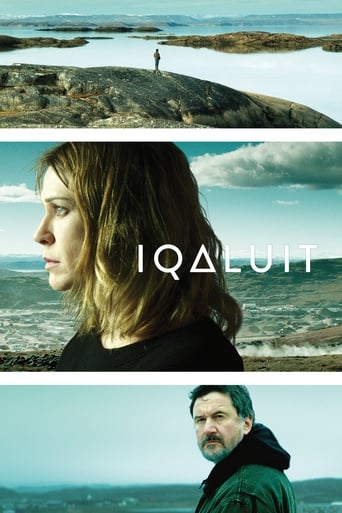
Iqaluit (2016)
In broad Arctic summer light, no truth can be hidden.
Travelling to the Arctic for the first time, Carmen arrives in Iqaluit to tend to her husband, Gilles, a construction worker who has been seriously injured. Trying to get to the bottom of what happened, she strikes up a friendship with Noah, Gilles' Inuk friend, and realizes they share a similar story. Together, Carmen and Noah head out on the Frobisher Bay - she, looking for answers to her questions; he, trying to stop his son from committing what can't be undone.
- Date of release
- 2016-09-15
- TMDB
- 7.5 / 10 (2)
- Runtime
- 1h 42m
- Genres
- Drama
- Director
- Benoît Pilon
Casting
- Marie-Josée Croze — Carmen
- François Papineau — Gilles
- Natar Ungalaaq — Noah
- Christine Tootoo — Ani
- Paul Nutarariaq — Dany
- Sébastien Huberdeau — Victor
- Kaalinnguaq Peter — Alamie
- Liu-Kong Ha — Dr. Nguyen
- Ellen David — Infirmière en chef
- Matt Holland — Officier McDuff
- Peter-Henry Arnatsiaq — Putulik
- Simon Nattaq — Paulosie
Interesting facts
Iqaluit is a 2016 Canadian drama film directed and written by Benoît Pilon and starring Marie-Josée Croze, François Papineau and Natar Ungalaaq. The film was shot in Iqaluit, Nunavut, which provided its title. It is about a Quebec woman (Croze) who travels to Northern Canada after her husband (Papineau) is seriously injured. She uncovers the secret relationships he had with the Inuit community, and becomes acquainted with an Inuk man (Ungalaaq) struggling with a related family crisis.
Production
Director Benoît Pilon wrote the screenplay, claiming he had the story in mind for nine years. Pilon stated his 2008 film The Necessities of Life gave him the curiosity to learn more about and capture the town of Iqaluit. A budget of $4.5 million was assembled with help from Telefilm Canada and Bell Media.
Pilon announced the casting of Marie-Josée Croze in summer 2015, with the cast also featuring Inuk actor Natar Ungalaaq, whom Pilon had previously worked with on The Necessities of Life. Ungalaaq accepted the role, saying "the director ... really believed I could play that role and I accepted that as a fact". Christine Tootoo was a novice actress from Rankin Inlet.
Filming began in Iqaluit on 20 August 2015, with 30 crew members from Montreal and 20 Inuit crew members. Moving the 10 tons of film equipment posed great obstacles, travel and accommodation costs were anticipated to be high, and temperatures during production were expected to be volatile. Plans were to film in Northern Canada for 26 days and in Montreal for one day.
During production, Daniel Justice, leader of First Nations and Indigenous Studies in the University of British Columbia, complained about a Facebook post from Iqaluit resident and crew member Pascale Arpin, seeking fellow Iqaluit residents to eat a seal for the film. The concern was that this amounted to cultural exploitation.
Read on Wikipedia · Text from Wikipedia, CC BY-SA 4.0. Data from Wikidata.
Recommended
- Between Two Worlds 2022 · ★ 6.9
- Malabar Princess 2004 · ★ 6.3
- Bloody Milk 2017 · ★ 6.9
- Secret Name 2021 · ★ 6.0
- Out of Love 2025 · ★ 6.9
- Grand Expectations 2023 · ★ 6.1
- The New Life of Paul Sneijder 2016 · ★ 6.0
- Adam's Sake 2025 · ★ 6.8
- Poor Cow 1967 · ★ 6.4
- At Work 2026 · ★ 6.5
- Valley of Love 2015 · ★ 5.9
- Eleanor the Great 2025 · ★ 6.8